Sunday, 26 March 2006

Piel Morena. Swedish Eyes

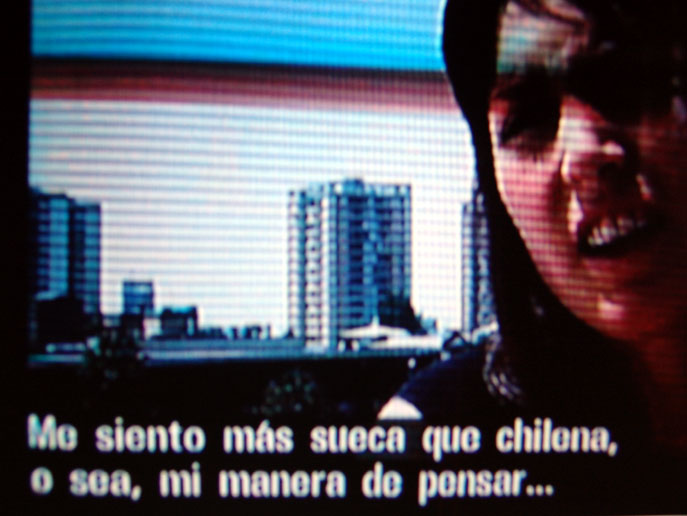
The documentary film "Piel morena Swedish eyes" directed by Rodrigo Ferrada-Noli Stoehrel (shown today anew at the Swedish Television Channel 1) it touches upon new and different perspectives on the acculturation related phenomenon of immigrant identity.

(Photos: Utbildningsradio)

Let me first declare that I have as policy not to comment publicly my sons' and daughter’s writings or cultural production published or shown in the Swedish media, however interesting they are, as I do regard them all. Rodrigo's recent documentary, nevertheless, touch upon some cross-cultural phenomena in the line of themes discussed previously here in this blog. Following, my comments on the documentary "Piel Morena - Swedish eyes" (for sending schedule of the documentary at SVT 1, here).
Three Swedish-Chilean young fellows, born in Sweden of Chilean parents - or born in Chile but grown up in Sweden since early childhood - manifest their views on prevalent cultural values and their experiences of being regarded differently, both in Sweden and in Chile. One of the main points being that they are – naturally, because so they have factually resulted by means of acculturation processes in Sweden – different to their Chilean counterparts living in Chile. The interviewed young Chileans-Swedes (or Swedes-Chileans) really impress with their psychological well being, clarity, harmony and integrity. All of them ostensibly proud of their Chilean origin or background. The director of the documentary film is himself Swedish-born and with a family background with mixed roots in Chile, Italy, Germany, and Luxemburg.
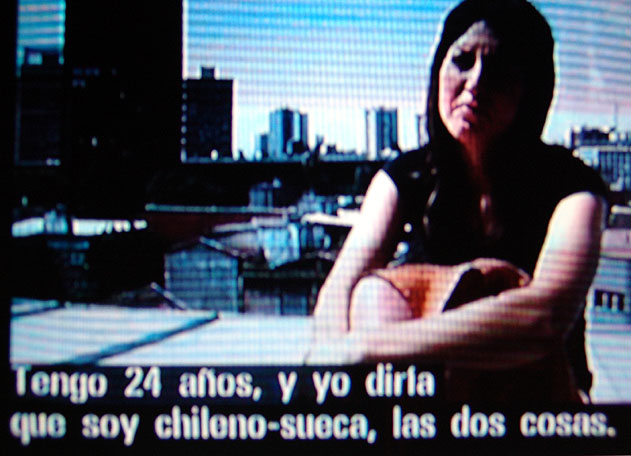
Sofia says that she thinks as a Swede, even when she is in Chile ("I have a Swedish skeleton and mind"). It became also evident in the underlying psychology disclosed by the interview, that having a Swedish analysis perspective, values, and even point of views, does not bother (perhaps a little bid the contrary) the young immigrants.

Most interesting here is that not only Swedish viewpoints are those becoming prevalent inside the piel-morena young-immigrant’s mind, but also the overall psychological “national-attitude”. For example, Sofia declares that she feels sort of guilt. This feeeling may be understood as arising even - or particularly- in front of her Chilean counterparts. Among other because, as Sofía declares, she had got so much in Sweden, such as a fantastic school, "språk", etc.

In a closer analysis,the Swedish-born Sofia may apparently feel so because this twofold reason:

a) She does not regard herself totally as a Swede, and "why would I have had so much, considering that my family is not originally from Sweden?" "Am I entitled to a full-Swede treatment"? one could read behind her lips.
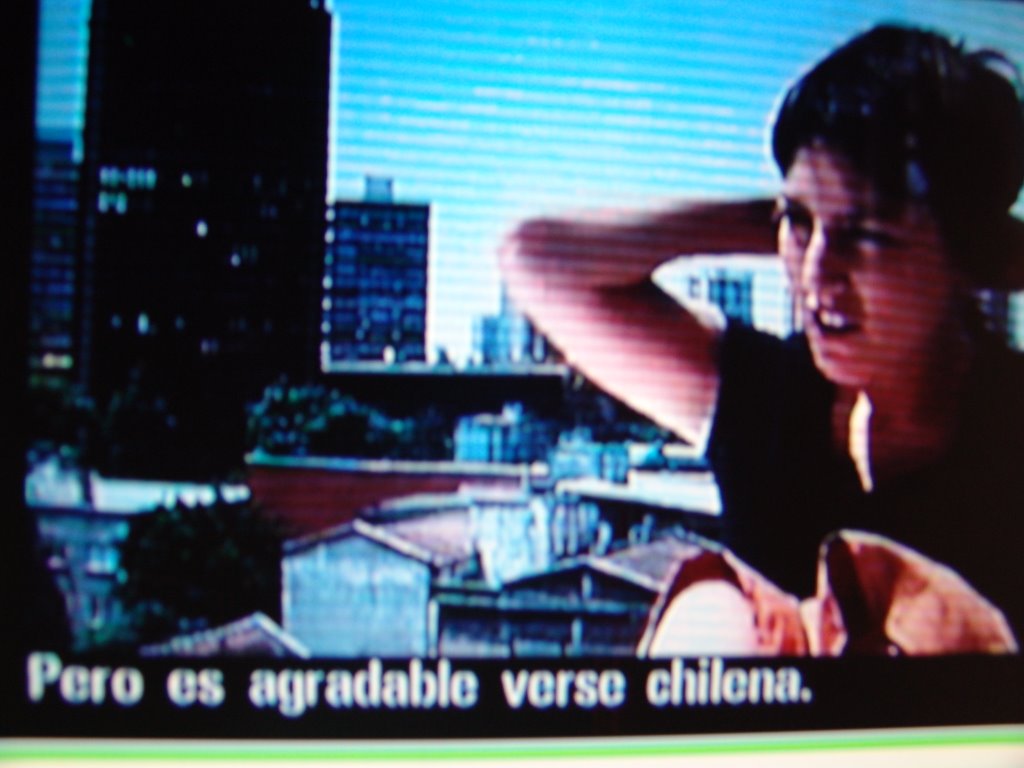
The above even in spite that she describes her exile situation as result of a forced migration, and of a political kind. Being her father a former political prisoner and tortured under months during the USA supported military dictatorship in Chile.

In this regard, I believe, she has fallen victim of the hyper nationalistic trap, the old discourse that only old Swedish ancestry would qualify for such national identity-share. It is outmost dramatic to observe how a central human right (based in jus solis) is in Sweden deleted among our younger generation. For they have absolutely equal cultural rights - not only juridical - in reference to any other Swedish-born in Swedish soil.

b) She lives with the natural and honest impression on that her Swedish way of living, thinking, etc. may be better than the Chileans in Chile, or to a great extent the result of what Sweden ("so much") gives to their youth.

But, it this not a bid of European supremacist view? Of course it is not the case of blaming Sofia and the young immigrants for this stand. It is, as I postulated above, pure and crystalline acculturation. One of the essentials, one could say, for an integrated society. Nevertheless, why Swedes would feel guilt in front of "they"? Why would we understand as less desirable the growing up under Latin-American cultural parameters, even if socio-economic indicators would appear (for us in Northern Europe) as not that "developed"? What about the quality of life?

The wide-spread national conviction that that Sweden is "best" seems to get deep into the piel morena of their young immigrants and reaching their brain and hearts.


Irene. Another main point elicited in the documentary is the view of young immigrants regarding how are they characterized by the Swedish society. The interview with Irene San Martin, a Chilean immigrant girl living in Malmö is clear and breath-taking. She asks why the Swedes keep on calling her "second-generation immigrant". What their children would be called, is a general wondering arisen in the documentary. Will they be called "third generation" and then "fourth generation immigrants", and so on and so for?

Just how many years paying taxes in Sweden would be requested from the integrated immigrants of the suburbs, how much sweat and health has to be tributed from the immigrant women, how much hard-work contribution from the part of immigrant workers to the Swedish well-being and welfare would ever suffy, for their children, and the children of their children, to be regarded as SWEDES?

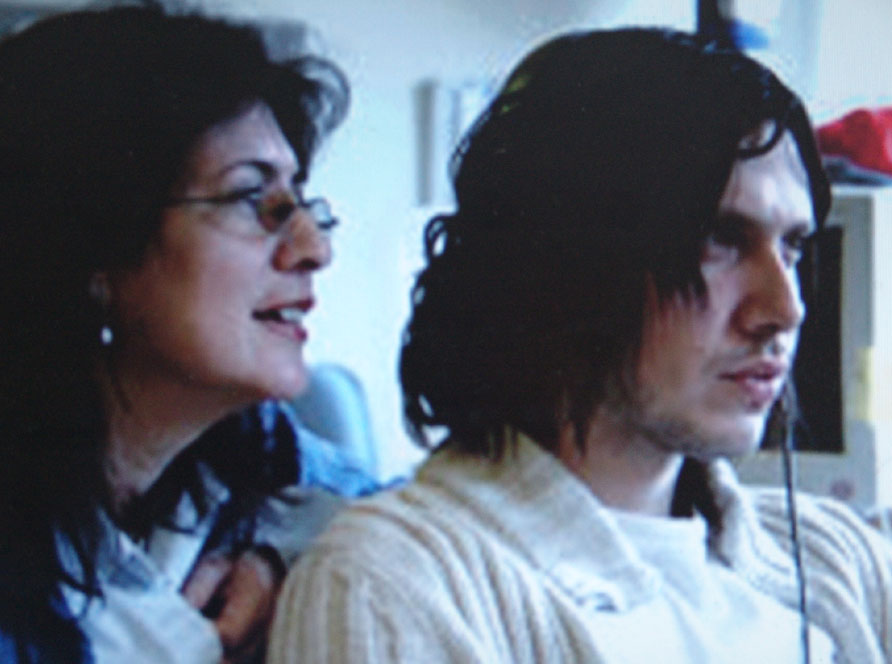
(In the photos, left: Laura Albanesi and Rodrigo Ferrada-Noli Stoehrel, Right; Esther Latorre)

The interviewed Rodrigo Avellán takes up yet another very interesting aspect.

He tells how his Chilean colleagues actually listen - and are ready to wide their horizon - when he comes with "Swedish solutions" for local problems the Chileans in his branch may encounter. What is the outmost interesting here is not what it is manifestly said in this regard in the documentary, but what surely it comes as immediately reflection by the viewer. Namely, that the Swedes hardly listen at the immigrants at their workshops and jobsites, even knowing that many of these have a well reputed professional background, etc. In fact, many Swedish institutions - structurally - neglect the immigrant manpower and their potential knowledge and aid.

Making us to think further
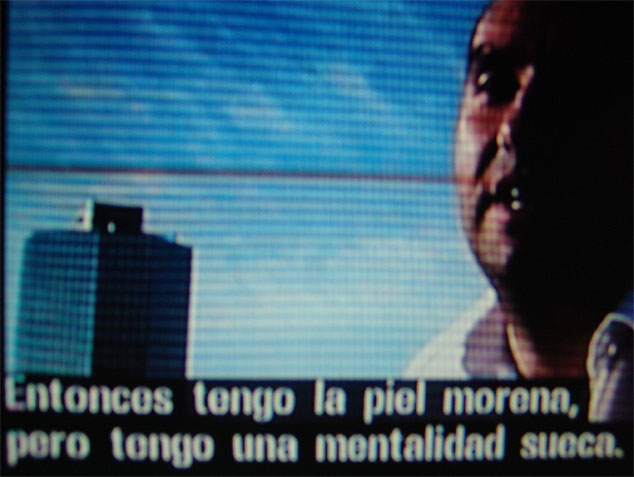
In sum, a positive, critical, and very interesting documentary, which has the main merit of invite for analysis and reflection on how Swedes and their immigrants can find yet a better path for enrichment of all cultures, here and abroad. In other words, as documentary films should be.

One more thing, viewing perspectives on the so called integration:

When acculturation ends and alienation begins?


Thursday, 16 March 2006

The contribution of ethnic discrimination to suicide.

For individuals already at risk for suicidal behaviour, discrimination added to social frustration may produce devastating effects.

I was asked today by a journalist student from Denmark for a statement concerning possible associations between discrimination and the increasing of suicidal attempts in Denmark among asylum-applicants. Quoting sources of the Danish Red Cross, he referred that such suicide attempts in Denmark "have increased from 1.8 pct in 2004 to 3.0 pct in 2005."
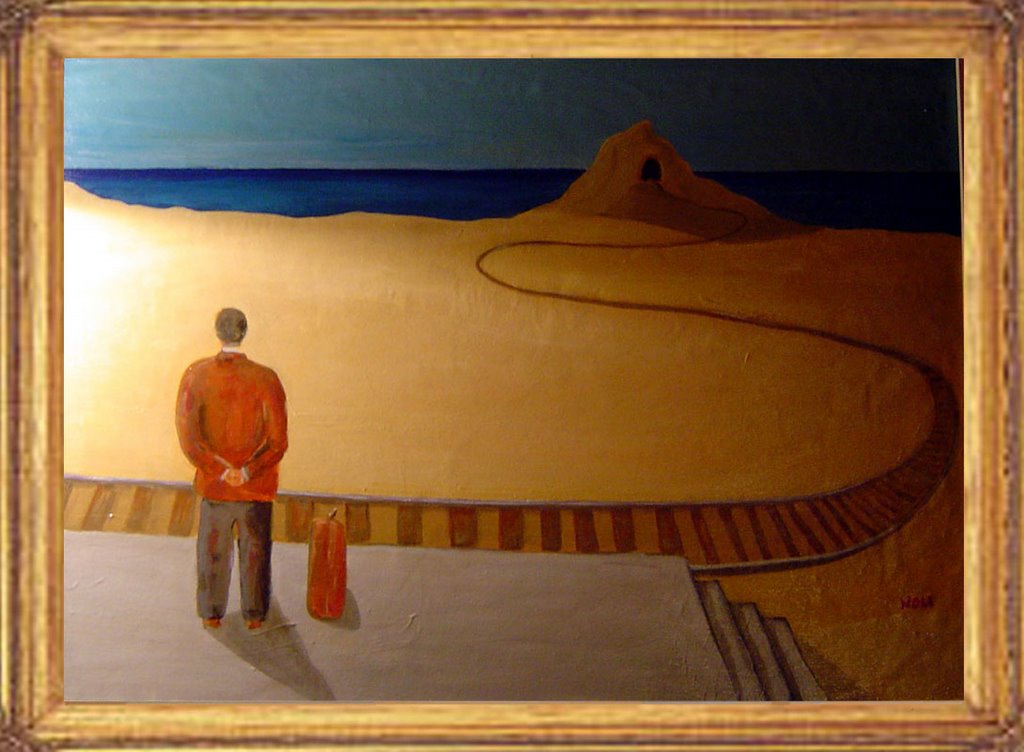
My painting One-way ride, 2004. Oil on canvas 70 x 80 . Click to enlarge

I have previously stated (in a SIDA conference at Stockholm University) that the hazards of negative or forced acculturation, problems in adaptation and uncertain existential conditions in the host country, and paramount, the psychiatric effects of posttraumatic statuses, make the individual vulnerable for the elicit of PTSD comorbidity (depression) or the enhancing of the eventually existing depressive states or traits.

Particularly sensitive with regard to suicidal behaviour are ideations of guilt arisen in exile (“I survived, others died”, etc) and in general the debut or worsening of the PTSD depressive symptoms or onset of depressive disorders as secondary diagnoses to PTSD.

But, what would be the contribution of ethnic discrimination to suicide?

Thinking in today's main debate article in Dagens Nyheter authored by a professor colleague (Jerzy Sarnecki), and in which I believe he had two main points:

a) He empirically confirmed that immigrants are sentenced to harder penalties than Swedes do, for the same crimes. Clearly, being this discrimination.


b) Discrimination, which leads to utanförskap, may lead through this towards criminal behaviour.

This is my reflection:

I wonder if the same dynamics may apply to suicidal behaviour. Discrimination reinforces psychological isolation, alienation, and the sense of unfulfilled life through the deprivation of social means necessary to accomplish social integration.

For individuals already at risk for suicidal behaviour, discrimination added to social frustration may produce devastating effects.
  • On the scale describing levels of acceptance of a society towards their immigrants, we use to say that at one end we find total integration, and at the other end we find total isolation. But the true is that the opposite of integration is in fact implosion.
  • Implosion, as in demolition, is the negation of integration and cohesion.
  • The ultimate probe or confirmation of a total lack of integration would be suicide.

The political question being, who is responsible for such discrimination.

The abstract of my presentation (at the Sida Conference) "Why do PTSD comorbidity and the suicidal behaviour of refugees and torture victims increase in exile? A social psychiatric hypothesis". here

Full text of my article in Läkartidningen (Journal of the Swedish Medical Association) "Traumatic stress and suicidal behaviour among refugees" (Traumatisk stress och flyktingars suicidbeteende ­ epidemiologiska fynd) here

To be continued

Wednesday, 15 March 2006

A mourning sea. Just a human tragedy. . .

What other name would you give to this painting?

Click on the picture for a larger view


I have shown this piece to the public only once, at my art exhibition organized by the Chilean Embassy in Stockholm. I have now, just a few days ago, been asked by Dr Liz Herbert McAvoy - on behalf of the organizers of an international conference to be held at the University of Wales, Swansea - for this painting's rights and with the purpose of using the painting as the pictorial motive for the poster, conference programme, etc.

Well, I would be honoured. That is one thing.

Nevertheless, reflecting on the possible risks and consequences commented in the blog next below, I wonder whether this painting may help to stress my point also there. You are welcome to read it, state your opinion (address:
marfer@ki.se) and suggest a name for the painting.

Friday, 10 March 2006

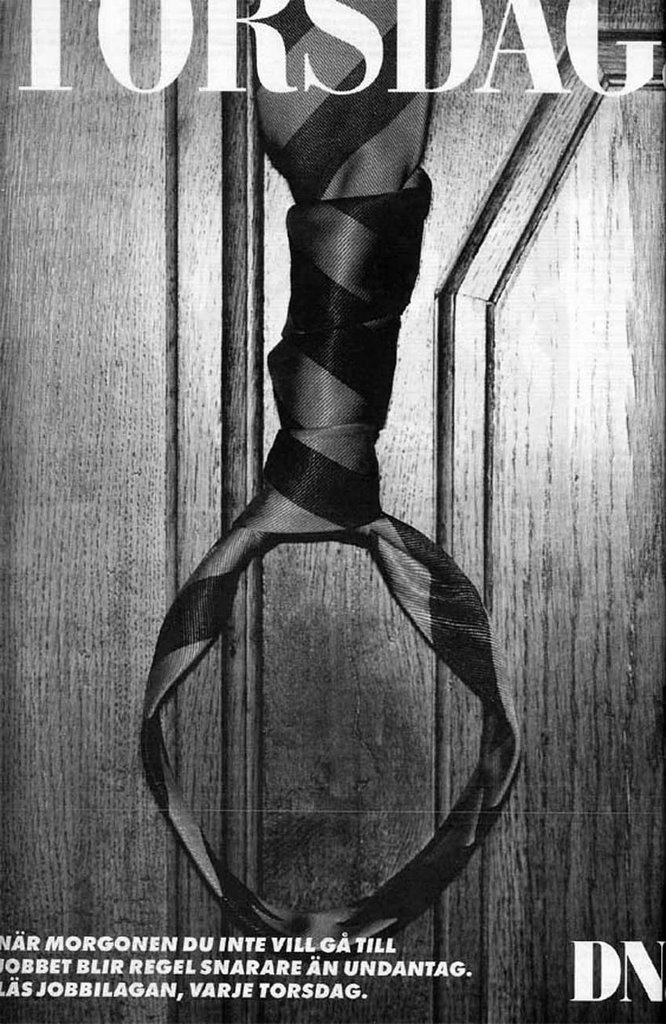
Dagens Nyheter's “suicide advertisement” made in disregard of potential increasing of fatalities.

Besides, flirting with such risks - for the sake of commercial advertising- might become a risk in it self. Negative reactions of ethics-minded advertisers and readers may probe to exceed expected profits for sexig advertising.

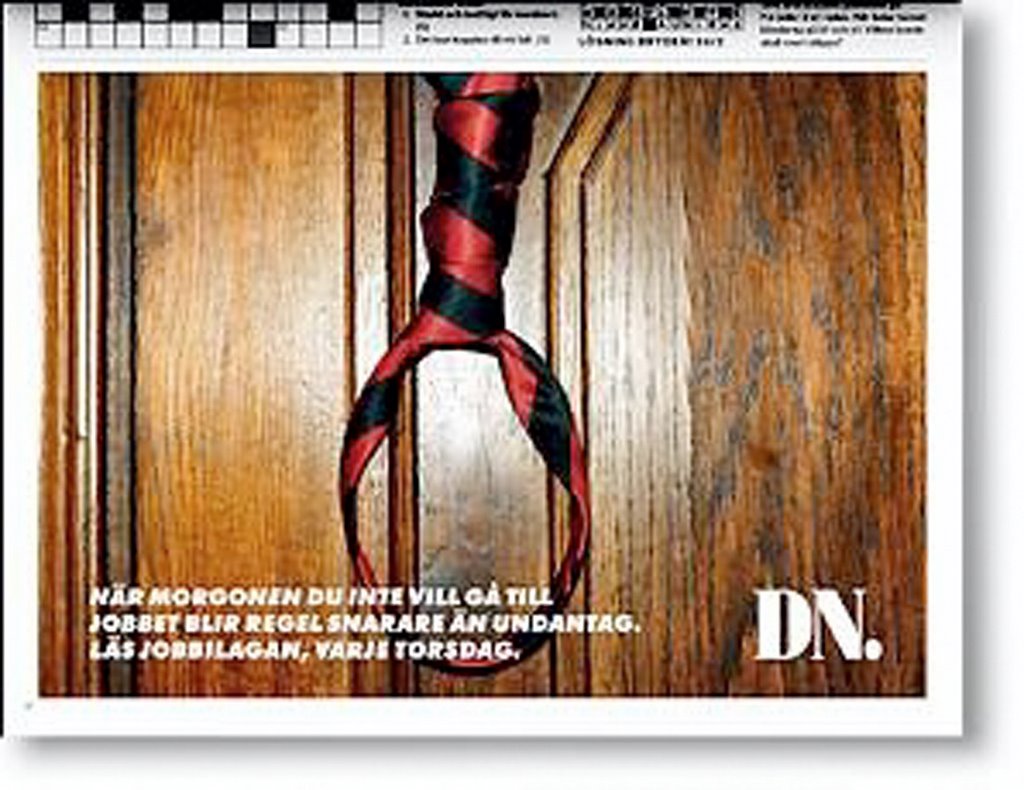
So, Dagens Nyheter responsible editors have decided to republish the criticized poster wich may be interpreted as containing - according to several I have interviewed - a hidden appeal for suicidal behaviour [see the blog next below or here]. This is made after a communication that DN has received, warning on further possible risks of an increasing of suicidal behaviour due to the republication of such ad.

The publication anew of the ad was made as illustration of an article by Lilian Öhrström, published in both the printed and web editions of the newspaper, on March the 1oth (see picture above). The particular is that Lilian Öhström, DN's own läsarombudsmannen, is also critical towards the publication of the ad.

According to DN läsarombudsmannen, the criticism to this publication that had arise among DN readers, apparently it focused on the "unpleasant associations" the advertisement evokes.

There are however other reasons, far more gravitating, which have been argued against the publication of such ad:

Dagens Nyheter does not mention in that context the serious warning they have received - based on internationally published scientific suicide research - on the eventual risk for increasing fatalities related to that ad publication. That appeal was expressly delivered by me to the DN editors on March the 8th (see box further down).

My contention is that there is a risk that such suicide-related imagery (like the full page ad - depicting a tie as if were a hanging rope) when published by main media, such as in this case the most important Swedish newspaper, may act as a trigger for underlying suicidal behaviour among indivuduals already at risk.


Well, on the other hand, someone can argue, among all the national groups in Sweden, those exhibiting significantly higher suicide incidences are not the Swedes, but the foreign-born immigrants.

This fact should be know by Dagens Nyheter since they have previously published a full-page article in DN Debate - authored by myself - focusing in the phenomenon of such overrepresentation of immigrants in the Swedish suicide statistics.

Further, it is also known that foreign-born immigrants are overrepresented in the statistics for unemployment or labour mobility and expectancy. It is of outmost relevance to have the above in mind when analysing the publicly declaration made yesterday by Jan Wifstrand, DN’s chief editor in which he said, defending the publication of the ad: “The advertisement shall be interpreted bildligt (picture-wise). If one uses the expressions that it feels as a rope around the neck it does not mean that some one shall commit suicide. An advertisement shall call for attention and reflection”, said Jan Wifstrand (DN 10/3/06) "

- Annonsen ska förstås tolkas bildligt. Om man använder uttrycket att det känns som en snara runt halsen betyder det inte att man ska begå självmord. En annons ska väcka uppmärksamhet och funderingar, säger chefredaktör Jan Wifstrand."(DN 10/3/06)

So, what is specifically the attention/reflection DN wants to call for in the ad?


"When the morning you do not want to go to the job becomes the rule rather than the exception"

And, what are your options if your are unemployed, or stack in your depressive job, or with none chances of getting a new job or a job at all? In other words, if you most likely are a bloody immigrant?

According to DN's instructions on that "of course the advertisement shall be interpreted bildligt (picture-wise)" .

So, one option would be to rush and buy Thursday edition of DN, in order to catch with their expensive job-ads allocated in the paper.

But if you are an immigrant who have tried hundreds of times to get a new job, or a job at all, your possibilities of changing your situation are statistically very small.

Another option DN offers you in the ad (you are supossed to "interpret picture-wise") is to go and use the hanging tie in the fashion depicted in the add, as seen in the picture to the rigth.

Some of my students, by the way, even “saw” the half of a funeral coffin at the right of the picture’s background.

Playing with this pictorial symbols is a highly risky business wich attempts straight against suicide prevention. The amount of international research on this topic, on the direct impact media has in increasing suicidal behaviour, is huge:

Only during the last decade over 230 scientific articles have been published internationally on such relashionships between suicides and the media (indexed by Medline).

That is why I had written a letter to DN editors - which receipt they opted for not to acknowledge. And now, through their insistence in publishing the poster in spite of being fully aware of such warning on possible fatal risks, DN clearly gives the impression that they do not care of such possible consequences.

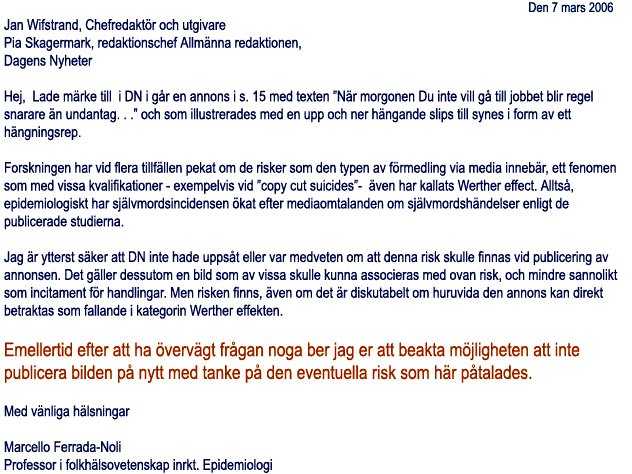
Here in the box a shorter version of my letter to DN editors

Dagens Nyheter can certainly exercise their right to ignore proven scientific knowledge whenever they wish, like in this case when that knowledge apparently goes against a rigid advertising policy. If not just a simple square case of Swedish-authoritarian "prestige" behaviour: Never publicly recognise being wrong.

But by doing this, DN shows not only lack of empathy towards an important cohort of human misery, but also an absurd ostrich standpoint.


Namely, ignoring a scientific research does not eliminate the scientific findings they refer to. Facts remain.

http://www.ncbi.nlm.nih.gov/entrez/query.fcgi?CMD=Display&DB=pubmed

Monday, 6 March 2006

A question for suicide research

Click the picture to enlarge
Appealing herald of a hanging tie. A new case of the Werther effect?
- Not, we hope.

Would the white-collar suicide incidence for the period March - April 2006 increase in Sweden (in comparison to previous period-prevalence & trend)?

The picture at the left, which may suggest the impression of a tie as a "hanging rope", is a full-page sized advertisement in today’s edition of the main Swedish newspaper Dagens Nyheter. The published picture is in colours and the legend reads:

"When the morning you do not want to go to the job becomes the rule rather than the exception"

The newspaper is marketing their own supplement (to appear later in the week) on advertised job opportunities. But, with a raising unemployment rate and a high competitive labour market, what are the options suggested to the one who can not change job or has been unable to get a new job, or a job at all?

In fact, the scientific literature has since very many years informs from time to time on the risks of suicide-oriented clues by the media (even if not produced with that intent, as it surely is the case of Dagens Nyheter), or of information on suicidal behaviour related subjects in the media, done by "non-professional" people.
Some of the latest of these empirical based publications appeared in the journal Academic Psychiatry, in Social Science and Medicine, and in Archives of Suicide Research. Here below are the abstracts of the articles with the corresponding reference.


Acad Psychiatry. 2005 Nov-Dec;29(5):495-9.

The media and suicide.
By Sudak HS, Sudak DM. Department of Psychiatry, University of Pennsylvania School of Medicine, USA. hsudak@afsp.org
OBJECTIVE: The authors aim to inform readers of the theory that when newspapers, film, and television describe suicidal deaths, additional suicides may result by virtue of contagion or copy-cat effects; to review data that support and refute this theory; to present some promising and recommended ways to prevent copy-cat suicide; and to cite news-media examples of both particularly bad and good reporting. METHODS: A review of the literature on media-related suicide was conducted, which included reviewing materials published in scientific journals and data published by the U.S. Public Health Service, Centers for Disease Control, and materials from private, not-for-profit agencies. RESULTS: Data support an increased number of suicides resulting from media accounts of suicide that romanticize or dramatize the description of suicidal deaths. Specific guidelines for the media that may be able to decrease these additional deaths have been devised. CONCLUSION: Psychiatrists should be familiar with the harm that may result from improper reporting of suicide in the media since they may be called upon by reporters or family members following the suicide of one of their patients or following the suicide of a newsworthy person. Following the media guidelines available may prevent such contagion effects from occurring.

Soc Sci Med. 2005 Dec 29;

The relationship between media reporting of suicide and actual suicide in Australia.
By Pirkis JE, Burgess PM, Francis C, Blood RW, Jolley DJ. University of Melbourne, Melbourne, Victoria, Australia.
The dead of Socrates. David, Jacques-Louis (1748-1825)
This study aimed to determine whether media items about suicide were associated with differential increases in actual suicides. Data were available on 4635 suicide-related items appearing in Australian newspapers and on radio and television news and current affairs shows between March 2000 and February 2001. These data were combined with national data on completed suicides occurring during the same period, by a process that involved identifying the date and geographical reach of the media items and determining the number of suicides occurring in the same location in selected weeks pre- and post-item. Regression analyses were conducted to determine whether the likelihood of an increase in post-item suicides could be explained by particular item characteristics. We found that 39% of media items were followed by an increase in male suicides, and 31% by an increase in female suicides. Media items were more likely to be associated with increases in both male and female suicides if they occurred in the context of multiple other reports on suicide (versus occurring in isolation), if they were broadcast on television (versus other media), and if they were about completed suicide (versus attempted suicide or suicidal ideation). Different item content appeared to be influential for males and females, with an increase in male suicides being associated with items about an individual's experience of suicide and opinion pieces, and an increase in female suicides being associated with items about mass- or murder-suicide. Item prominence and quality were not differentially associated with increases in male or female suicides. Further research on this topic is required, but in the meantime there is a need to remain vigilant about how suicide news is reported. Mental health professionals and suicide experts should collaborate with media professionals to try to balance 'public interest' against the risk of harm.


Arch Suicide Res. 2004;8(2):137-45.

A dose-response relationship between imitational suicides and newspaper distribution.
By Etzersdorfer E, Voracek M, Sonneck G.
etzersdorfer@fbkh.org
Although the Werther effect is well known, up to now a correlation between the differential distribution of particular media reports and subsequent imitational suicides could not be found. This study investigates a celebrity suicide by gun in Austria, which led to extensive reports in the largest Austrian newspaper, whose distribution shows substantial regional differences. The numbers of suicides by firearm in the 3 weeks after the reporting showed an increase over the 3 weeks prior. Regional analysis revealed a strong correlation of suicides by firearm and distribution of the newspaper (log odds ratios; r(9) = .62; p = .04, one-tailed). This dose-response effect explains 40% of the variability of changes. These results underline the influence of media reports on suicidal behavior.

Sunday, 19 February 2006

The one & only reason for recognizing Israel

Equivocal pressures towards the new Palestinian leaders may instead confuse the logical and geopolitical premises of facts around the existence of the Israel state. In the same factual fashion, a Hama majority elected government does exist in Palestine, regardless anyone’s wishes of regarding that truth as unreal.

In the aftermath of Hamas victory in the Palestinian elections have EU and other Western sectors of interest put forward a main threat to the new elected Palestinian leaders than can sumarizes as: “Do recognize the existence of the Israel state now, otherwise we shall stop the economic aid to Palestine”. The Swedish government seems to rapidly have endorsed that formulation.

It is beyond doubt that the intention of the threat is just to get the new leaders on the course of a peace-policy under terms serving EU interest in the region. So be it, that is what international politics is about. But the argument is indeed utterly absurd - and even if unintentionally- nontheless insulting, and risky. The money related argument should be immediately eradicated from the above formulations.

The one and only argument it should be that the existence of the Israel state has to be recognized because their habitants do have the human right to exist as the nation they are, exactly in the same way that the habitants of a Palestinian state have, or for that part the Swedish people does.


Furthermore:

EU can not possibly “buy” the formal recognition of Israel from a political movement which have made its political advances in Palestine through, among other, their critic of the alleged corruption and penny-related orientation in some decisions about state business in Palestine.

In the second place, EU and the countries there belong did not decided to grant this aid to a certain government in Palestine, but to all Palestinians and for helping covering their needs of development of their institutions towards the secure of minimal wellbeing for all.

In the third place, this aid has been so fundamentally necessary due to the embargo and the economic/political blockage imposed by the Israel government and which affects the entirely Palestine population.


If EU or USA does not wish to spend their money in Palestine, they should instead put pressure on Israel towards a lift of such draconian measures that the ocupation of Palestine territories have signified for ordinary Palestinian's lives, irrespectively of political militancy.

Strictly, frontiers in this world are an accident of civilization's wrong development.

Support the continuation of fair peace talks in the Middle East!

The Guardian cartoon

ADDENDA

In the leading article Occupation is an obstacle for peace by the former USA President Jimmy Carter, published in Dagens Nyheter on March the 10th (translation of Henrik Berggren), the author summarizes approximately the same standpoint I wrote above (19 of February) in regard to the need of mutual recognition - between Israelis and Palestinians- of the existence of their respective states, and the characterization of Israel occupation of Palestinian soil as deplorable for the cause of peace. Jimmy Carter was chairman in situ of a main observer team during the recent elections in Palestine. This is the summary according to the DN translation:

”Vi behöver inte ge upp hoppet om en permanent fred för Israel och frihet och rättvisa för palestinierna om tre grundläggande villkor respekteras:

1. Israels rätt att existera - och leva i fred - måste erkännas av palestinierna och alla andra grannar.

2. Dödandet av oskyldiga människor genom självmordsattacker och andra våldshandlingar måste upphöra.

3. Palestinierna måste få leva i fred och värdighet, permanenta israeliska bosättningar på deras mark är ett stort hinder för att uppnå detta mål”.

In the picture Jimmy Carter together with Nobel Peace laureates Anwar Sadat and Menachem Begin, after signing a peace treaty between Egypt and Israel in 1979.

Tuesday, 14 February 2006

A clump in the throat


The horror of gang's physical abuse against defenceless victims


The physical abuse of gangs against single individuals it is awful, unethical, and an act of genuine cowardly. Nothing for real men. Deliberate adult physical violence against children or teenagers is more than horrible. But a gang of soldiers with helmet, boots, equipped with sticks and firearms weaponry, beating on and on some children until they collapse in pain, has no term, no noun, and no verb to be referred.

Provided that exile for many of us it was an external determined fact (forced migration, as it is called in modern times. The original name being ostracism), the main question is not why are we here but whether destiny has given us a worth reason to die in another place than we were born.

Attending a private memorial at a churchyard in the neighbourhood on the morning of New Year’s Eve, I realized that I have lived in Sweden the most part of my life, altogether, more than thirty-two years. I was then confronted to the following quest.

What could I say on what is it good and what is it bad in this, my country of exile?

Frankly, I found very many good things. And I found just very few negative ones. Sweden may not be the hyper fantastic country which some advertise. However, in comparing this country with all rest, very many of us would hardly find a better one to live in, considering the overall factors.

The theme developed here is about one of those few things.

Some days later that New Year’s Eve, to be exact on January the 8th, I wrote this letter to two colleagues at the University of Gävle:

Dear colleagues,

I would like to invite you to reflect over the following:

I was told of this story by a psychiatrist, working at that time at Danderyd Hospital.

She is in the subway towards her job. Just a bid away from where she is seated, three skin heads start, unprovoked, harassing an immigrant woman. The woman just seats there, looking down to the floor. The skinheads get more and more excited.

"Suddenly, the skinheads start to hit the woman, now and then, here and there", she described. "A Swedish man in the seat beside, well dressed, and around the age of 35-40, gets apparently very upset with what we witness. He then takes quietly out his cellular, and makes a call speaking in a soft voice. "

- "I called the police" - the man said to my friend "looking with a genuine satisfaction on his face, and proud in his air of appearance." My friend tells me she could not hear however what he exactly said over the phone.

Rightly, two subway-stations after, two police officers - a man and a woman- enter in the wagon equipped with a decisive attitude and with their batons on hand. They go directly where the crushed and beaten immigrant woman is, handcuff her, and hurriedly took her out under arrest.

That was all, and the train continued. Peace in Sweden could go on.

End of the letter. The above story was told to me several years ago. Some details have may fade away and others must have changed through the several memories elicited differently from time to time, whenever a similar case of abuse - like the one I refer at the end of this chapter - pops up in my reading horizon.

This is the thing:

One problem that always has puzzled me about modern Sweden is that Swedes do not always intervene when confronted to the sight of physical abuse to defenceless victims on the streets, subways, public places, etc. I do not imply that they do not react. They surely do, but it is not allways expressed in a more concrete fashion.

I have been living here for more than 30 years (after been a Geneva Convention refugee, which was after I have been in Italy, which was after I have been in Pinochet's concentration camp of Quiriquina Island, which was after I was professor at the University of Concepción, which was after I participated in the foundation of MIR - a movement of the new left of the sixties). I could say that during this long time in Sweden I have not seen here often, or hear often, on others than immigrants to stand up for the one beated up, regardless ethnicity.


The above personal impression, also based on my readings, while it may be true is nevertheless not utterly just.

For there are notorious cases in which young Swedes have even sacrificed their lives when intervening and combating gang violence on behalf of the individual defenceless.

So it was not before, generally speaking. In the early seventies I visited Sweden as university student. I lived then in Frescati, the university campus in Stockholm. It was definitely wilder that it is now (me included). Many things could happen. In most of those things there were the Swedes, intervening, rescuing, and behaving.

What has happened? Is it violence which has changed? Is it people's sense of solidarity? Or both, or more?


A Swedish taxi driver in Umeå, commenting the harsh violence of gangs beating up some one guy "already on the ground", told me: "In our times, when I was young, this never could happen in Sweden". "Certainly we had fighting, but never this way, it was more fighting as a man", he said. What did he concretely meant I could only guess. But in this case I reckon I guessed right.

The physical abuse of gangs against single individuals it is awful, unethical, and an act of genuine cowardly. Nothing for real men.

Deliberate adult physical violence against children is more than horrible.


But a gang of soldiers with helmet, boots, equipped with sticks and firearms weaponry, beating on and on some children until they collapse, has no term, no noun, and no verb to be referred.

It is just to be fought against.

I saw at BBC news a glimpse of the video reproduced from News of the World. We saw it suddenly popping up among the news, in family. While some could not stop the tears, other felt a stiff clump in the throat. But also we felt something distinctly else.

I have found today the original version of the video by News of the World. It is more detailed than the news version of BBC, Sky news or SVT. In the SVT short-edited version the most relevant and dramatic sequences of the video are replaced by the pictures and interview of Tony Blair! Here below I show a video I did film myself directly from the TV screen while Skynews went on.

I take my risks in showing it here with the hope of having my Swedish and immigramt colleagues of all adult ages reacting as the old taxi man in Umeå. I expect to share not only my sorrow, but also my rage.

Click on camara below
for the video