Tuesday, 6 March 2007

Livslängd i Niklas Ekdals inlägg ”Fablernas värld” I

Livslängd i Niklas Ekdal ”Fablernas värld”
Kort inlägg avseende temat livslängd i ”Fablernas värld” av Niklas Ekdal (DN 25/2)
(Niklas DN-artikeln här). Mitt inlägg - insändes till DN 26/3 - publicerades ej av tidningen.

I sammanhanget av kontroversen mellan ”feminister och biologister” (DN debatt 18/2, 20/2) menar Niklas Ekdal i ”Fablernas värld” (25/2) att skillnaden i livslängd (Lvl) mellan svenska kvinnor och män – 82,78 respektive 78,42 år- står att söka i männens ”risktagande, missbruk och hjärtinfarkt”. Männens beteende, således.

Emellertid är skillnaden inte en specifik svensk företeelse utan generell för industriella länder. Vidare är skillnaden – ur ett socialmedicinskt perspektiv – inte primärt orsakat av könsmässiga faktorer utan i samhällets arbetsstruktur. Män – i synnerhet bland arbetarklassen - har i generationer varit relativt mer exponerade till den tillhörande arbetsmiljön.

Medicinska framsteg och förebyggande insatser har resulterat i ökad Lvl för båda könen. Viktigt att konstatera är däremot att kvinnornas Lvl inte längre ökar i samma takt som männens (nu den längsta Lvl bland EU länder). I mitten av 1980-talet var Lvl 80 år för kvinnor och 74 år för män (källa Folkhälsorapport 2001). Förmodligen i samband med kvinnornas lyckade kamp för att successivt tillträda i arbetslivet har även deras andel bland folkhälsosjukdomar ökat och tenderar att jämnas ut med männens.

Icke desto mindre är den medicinskt vetenskapliga genusforskningen högt behövlig för att just berika en annars ”hopplös debatt” framsprungen ur en politisering av könsroller, som Niklas själv varnar DN-läsaren för.


Marcello Ferrada-Noli
Med dr, professor i folkhälsovetenskap

Wednesday, 13 December 2006

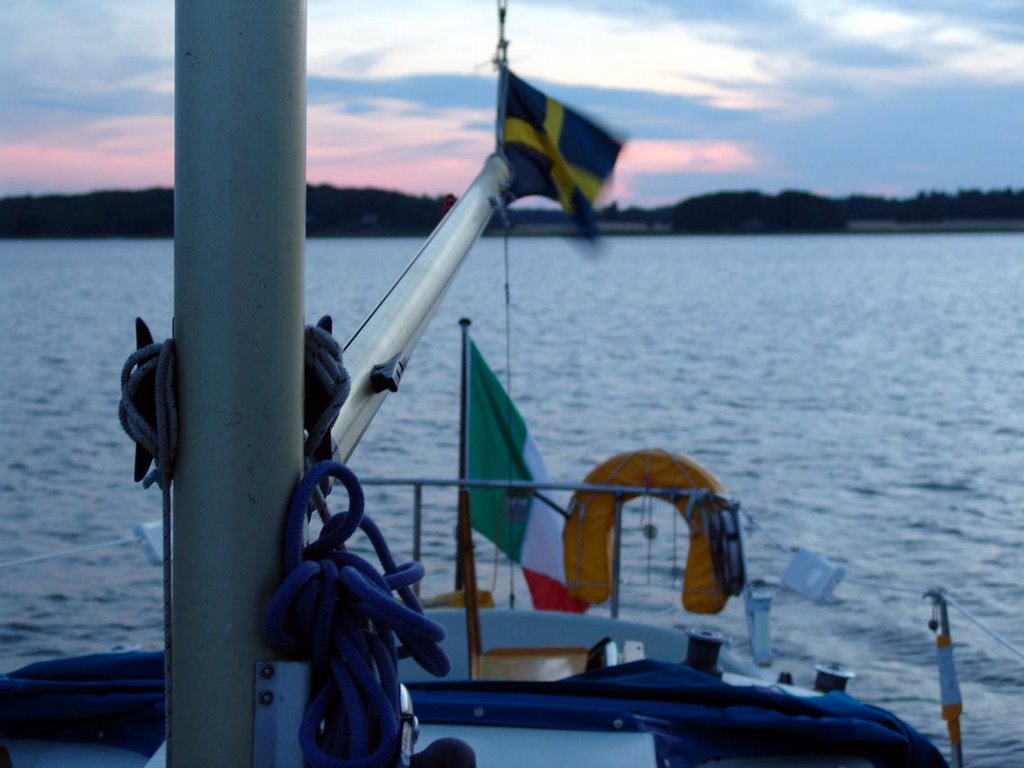
My "Mourning sea" became poster at the University of Wales


Remember my Mourning sea?

It now became a poster for the Conference on
Widowhood in History, Culture and Society, at the University of Wales Swansea

click to enlarge

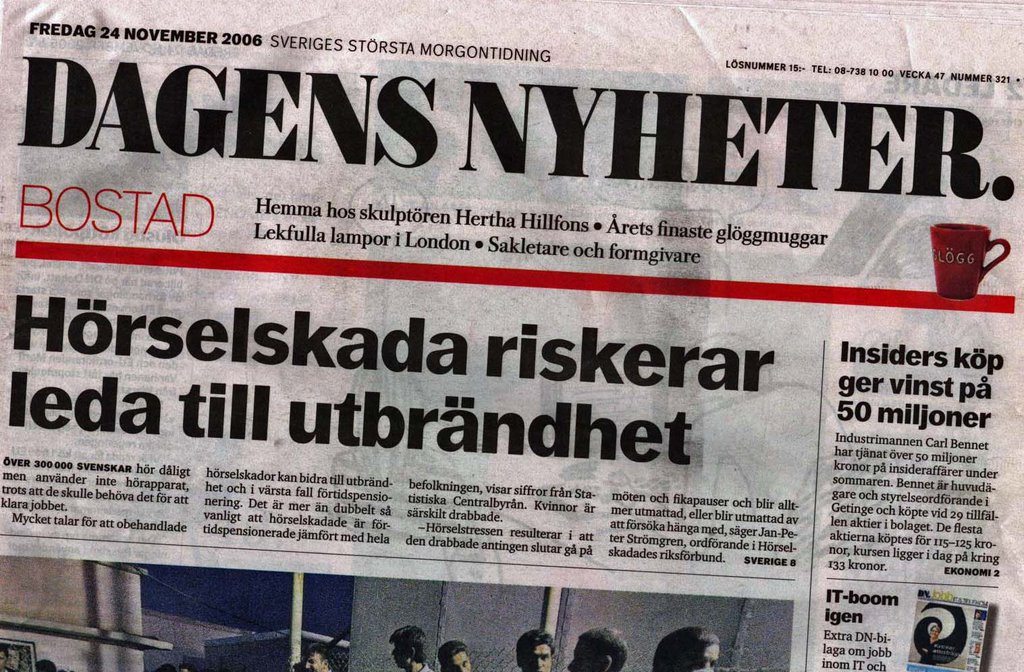
New unsubstantiated alarm on pathological burnout (utbrändhet) in Sweden. Where is the proof?

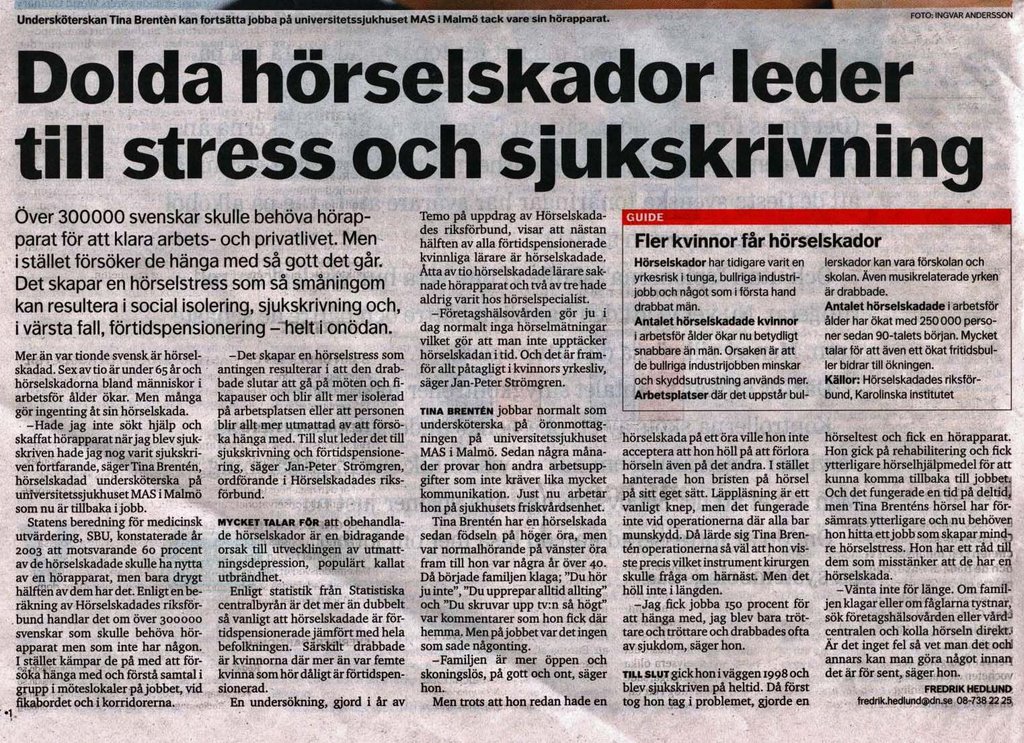
Hearing problems risk leading to pathological burn-out ("hörselskador riskerar leda till utbrändhet"), it is now reported. The "scientific discovery” appeared as the chief headline-news in the front page of the main Swedish newspaper Dagens Nyheter 24/12 2006. But, where is the proof?

There are whatsoever no news-value in reporting that problems in hearing adequately can lead to irritating and stressful statuses in both the one with the hearing problem and his or her interlocutor/interlocutors. Neither can it be found any controversy in stating that a given fraction among the individuals with that partial or minor hearing handicap is in fact not aware of their disabling. Being the last category identified in the article as “hidden hearing-problem” (individuals with “dolda hörselskador”).

But to infer from the above statements, that “hidden" or unknown hearing problems is a cause of pathological burn-out / utbrändhet (a Swedish "diagnostic category" which in its turn can easily makes the individual eligible for long lasting sick leave and subsequently retirement - beyond medical verifiable proof), it is logically untenable and unscientific. And most sensitive, it leads to unfounded alarm among the public, and to increasing missconceptions.

The “facts” sustaining the alarming report

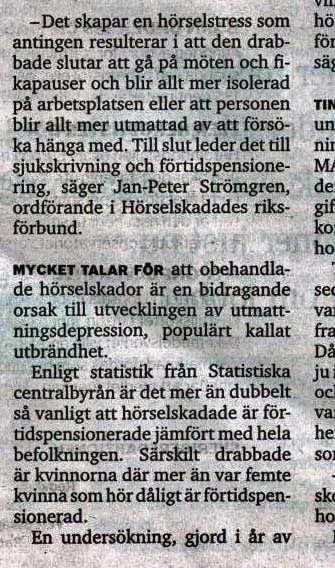
When we look into the article’s text we do not find whatsoever any conclusive scientific proof, no epidemiological evidence, for the main statements in the headings. The ONLY thing there offered is:


Very much indicates (Mycket talar för) that untreated hearing problems are a
contributory cause to develop pathological burnout (“exhaustion depression”, utmattningsdepression), also popularised under the term utbrändhet.”

And what is that “Very much”, or what is the source for that clinical conclusion which can be epidemiologically bound to pathological burnout?

Well, that the chairman of the interest-association of individuals with hearings problems has said to the journalist that some teachers eventually feel isolated and tired in their efforts to follow (hänga med) the conversations in the coffee break!

All the rest of statistical-filling in the article have absolutely no bearing for the stated conclusions. For instance information on the percentage-estimations among women teachers with hearing problems which do not use technical aids, etc. Or that nearly the half among the women (why not men?) that early retired from their teaching jobs reporting to have a hearing problem.

At the very same time, puzzling enough, the article reports that two thirds among those teachers above have never being to a doctor specialist in hearing problems!

Is it stress or environmental noise what causes the hearing-impairment?

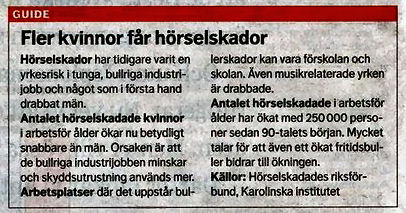
Further, what is the evidence - as the article implies (see the "Guide" box inserted in the article) - for that the noise at pre schools or schools in Sweden is significantly worse now than it was during the free and indulging seventies or eighties, during the "laisse faire" pedagogic era (the "let-them-behave-as-they-feel" educational rule)?

Or that since the "beginning of the nineties” music it is played at significantly higher volume in comparison with the seventies or eighties?

These alarming – most often unproven and unsubstantiated – media reports, do seriously contribute to the false notion among the public that they may suffer of such pathological stress that it makes them difficult or impossible to perform socially, with their families, or to fulfill even partially their jobs.

The question is also why Dagens Nyheter, otherwise a serious and well reputed major newspaper in Sweden, has seemingly indulged this pro-utbrändhet campaign?

Just how many articles or reports which are critical, or even offer factual and scientific proof against the utbrändhet-thesis, are given space in the newspaper?


Monday, 16 October 2006

Does really OVER THE HALF of Sweden’s young women suffer of burnout? More alarming figures in the Swedish Radio

October the 16th 2006. “Every second girl at the secondary school has symtomps of emotional exhaustion (symptom på utmattning)" broadcasts today the Swedish Radio programme The Scientific Radio - Vetenskapsradion.


The Public Service / Swedish Radio programme The Scientific Radio announces today’s - in its main news - the circulation anew of Dr. Aleksander Perski’s book Ur balans "that comes out in a new edition today”.

Psychologist and Associate Professor Aleksander Perski, who according to the broadcasting "is also the chief of the stress clinic (Stressmotagningen) that operates in cooperation with the Karolinska Institutet", states himself in the Scientific Radio:

"There are actually big quantities of young girls which are in the risk zone of future health problems. And the deterioration is very much about doing their homework, performing, eventually working extra in order to earn money for clothes for looking good, and much worries, and one can suspect that they also compete very much with each other, and so". ["Det är faktiskt väldigt många unga tjejer som är i riskzonen för framtida hälsoproblem. Och försämringar handlar väldigt mycket om att göra läxor, att prestera, eventuellt jobba extra för att tjäna pengar för kläder för att se bra ut, och mycket oro, och man kan misstänka att man också tävlar mycket med varandra, och så"].

The journalist of Scientific Radio:

"He (Aleksander Perski) has done himself the investigation contained in the book that comes out in a new edition today. Two hundred students of second year at three high schools in Stockholm had answered a questionnaire about life-style and selfconfidence. And over the half of all the girls complained about symptoms of exhaustion such as problems in concentration and sleeping problems" ["Han (Perski) har själv gjort studien som finns med i boken som kommer i ny upplaga i dag. Två hundra elever i årskurs två i tre gymnasieskolor i Stockholm fick svara en enkät om livstil och självkänsla, och över hälften av alla tjejer klagade på symtom på utmattning som koncentrationssvårigheter och sömnproblem"].

The author finally warns in the broadcasting on the perils of the vulnerability that this (stress-related) problem among Swedish young women represents, towards a worsening of their health as adults. Several adult women - as patients at Stressmottagningen, says Perski - have rooted their problem to their school years.

My comments:

Provided that the measurements are correct (as surely they are),

  • How scientifically certain is the conclusion that the mentioned symptoms (problems in concentration and sleeping problems) have unmistakably its cause in psychosocial/environmental items such as stress, and not possibly related to other causes such as natural grow related to age and development, or to other health problems?
  • In other words, how can we directly connect those symptoms exclusively with "utmattning" (emotional exhaustion or burnout)?
  • Do we have several measurements of this same kind conducted in Sweden among the same groups and at the same environments during different years in the past, so we could drawn a possible trend?

I assume that a problem of such epidemiological magnitude as the reported now by Vetenskapsradion among Swedish girls ("over the half” of all girls suffering of symptoms of exhaustion) would have determinant consequences in the scholarly performance.

However, just recently - in fact during the last week - the news reported that Swedish girls have a better school performance than Swedish boys have.

Would this mean - paradoxically - that boys are even more represented in the statistic of exhaustion symptoms than girls are?

As a matter of illustration, allow me to remind that also today (16/10 2006), the same Swedish Radio reported a notably increasing in the number of young women - i comparison with their male counterparts - being selected for admission to (the hard competitive) medical schools. The trend further shows than more women doctors than men will be soon the reality in Sweden. Would the findings commented here indicate instead a panorama deterioration in the expected academic future of young women decimated by pathological stress or exhaustion-depression symptoms?

So, what is what?

Alarming figures on increasing stress, emotional exhaustion and burnout among sectors of the Swedish population - from the part of stress researchers or companies with professional interests in current rehabilitation programmes - are of course no surprises here. It is in fact just natural, or understandable, that those professionals would try promoting the results of a research which is close associated with the declared aims of such enterprises. But this is not my main objection here. The main question here is instead:

Why the Public Service media gets over and over tuned in this repeated wave of broadcasting "stress" alarm among the Swedish public?

At the same time, at the same public service media of for instance Swedish Radio, while politically correct stress researchers are called one after the other to exhibit their unopposed parade of alarming - and to certain extent dangerous - statements, no equivalent space is given for scientific analyses that may question the official epidemiological deception - in the sense of genuine massive epidemy - of the phenomenon called utbrändhet.

Less than a year ago had Aleksander Perski in a long interview done by the same Channel 1 at the Swedish Radio bluntly broadcasted to the Swedish people - with no direct reaction from the part of the interviewing journalist- the following arbitrarian figures (with regard to how many among the Swedish people would at the time have poor health, meaning "feeling bad due to stress"):

And just how many they are? "30 percent of the Swedish population. Of these, 15 percent because they work too much, and the other 15 percent because they work too little" (from the interview with psychologist Alexander Perski, Studio 1, Swedish Radio 19/12-05).

The figures given by Perski means nonthing less than THREE MILLIONS of Swedes having this problem upon their mental health. A problem for which the best treatment, or "rehabilitation", according to Perski himself, would be found at Stressmottagningen.

All above it remind us of

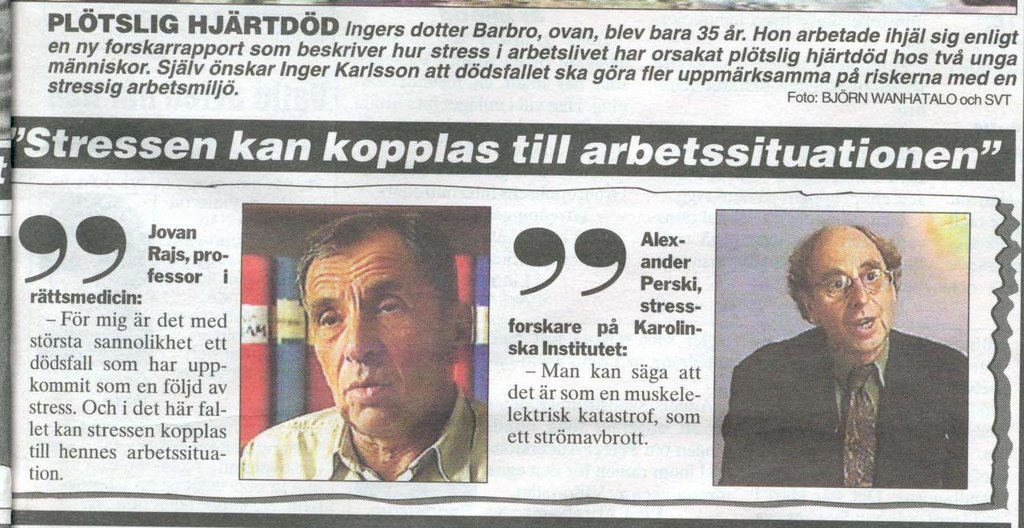
a time back in the history of the Swedish burnout epidemiological deception, where we find the following headline in the front page of the evening paper Aftonbladet - also after an interview with Aleksander Perski (and Jovan Rajs) 2000:

"SWEDES ARE DYING OF STRESS"

I have no evidence that Aleksander Perski himself had publicly concluded the desvatating statement above, published in an Aftonbladets' frontpage, and I do not believe he has done that off the record either. But the media has its own so called dramaturgia and uses research results - or the opinions of researchers - in their own bussiness of magnifying the presentation of a problem.
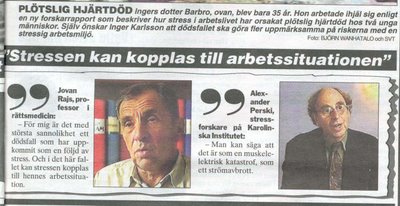
Anyhow, the statement was also a clear exaggeration. Such epidemy did not exist then and never existed later either. As I could soon later established in an article which I published in the Swedish Medical Journal (Läkartidningen, 97, 50, 2000). Among women in working age, less than two women per year died of "sudden death", respectively less than six men. And above that fact, the year trend in such deaths was actually decreasing during the "stress years" of the nineties.

When will Swedish serious journalists and editors - in this case from Swedish Radio - understand that an important segment among the worries ("oro") affecting the mind of the public are those based, or contributory-caused, by the often alarming reports on "increasing (pathological) stress" broadcasted / published acritically by the Swedish media?

As for Dr. Aleksander Perski, he is just doing his job.

Sunday, 17 September 2006

Theses on the cultural premises of pseudoscience

Religion is to believe in the unbelievable, to accept as true what is not proven, to render human dignity to powers of fantasy amid despair. In this wining war of the rich against the poor, of the opressor’s religion against the religion of the ruled, in this war of the smart against the ignorant – the cast in power needs priets, psychologists, therapists, and segments of the medical establishment that can make us believe that what is wrong around us it is something else than the unfair status resulting of devastating deterioration of social justice.

In other words, several politically correct stress researchers or therapists risk with their public interventions to be taken as the ultimate pro-alienation ideologists, meaning mental professional assisting in the goal of making public opinion to shift from the huge, real macro problems in society, to ego-inwards micro situations. They seem wanting to convince the individuals that his/her sufferings are reduced to a supposed weakened mind and body eroded by a stressful emotional burden, to a wrong stress coping, or a "too much" altruistic engagement towards others.

The question is, what on earth does exist in terms of scientifically verified evidence to sustain the fashionable nonsense that the "stress" a person "suffers of" is only job-related? What are the political and ideological premises for the cultural presence of this pseudoscientific trend?

Essay by Marcello Ferrada-Noli. 17 Sept 2006

I

Pseudoscience in the macro-political context
Regensburg, Bavaria, September 2006. Pope Benedict XVI publicly opposes to Islam the means of western Catholicism, right at the time of the geopolitical conjunction of USA-European troops occupying Iraq and Afghanistan. But can this apparently war for the souls-and-minds against the fundamentalist followers of Islam hide with any elegance the one and only conquering agenda?
Can anybody with a brief two centuries retro-glimpse doubt an aim in the easy capturing of natural resources in territories belonging to developing-countries with low military response?

Already since Cristoforo Colombo was discovered by the Indians in America, they realized that nearly close behind the formations of Spaniard swords, a line of Christian crucifixes was there to conquer the gold of their “heart and souls”. No South American booting would have ever been possible at that scale without the
alienating help of the peoples’ opium. The pope of the time, Bonifacio, had even through bula pontificia declared that the overseas enterprise was aimed at a religious redemption. But the aim was gold, no matter how vast the genocide inflicted to the redeemed.

The thesis here is not that Bush or some staunch European allies - and the hyper industrial/finance complex they represent - are personally “eviler” than Reagan or Thatcher or Pius XII. It is not there where the qualitative change in the all-out strategic offensive is to be found. But rather in the fact that West governments have not any longer in front of their NATO tanks – unlike their predecessors - a strong enemy block equipped itself with a huge deterring potential. In the main, only the parity-vacuum resulted from above, known as Détente, could corollary serve to the threatened developing countries during the cold war times, as a geopolitical buffer against invasions such as the today in Iraq.

A world focused in the high vicissitudes of nuclear war ad portas among the industrial nations, and of intense anti-colonialist liberation movements among the emergent nations, it is a world in which life is at the stake and tasks of physical survival a priority. Amid this primal perspective of the society we lived in, duties of solidarity from the part of every decent citizen were the self evident ethical leitmotiv.

For every such individual his/her main focus was naturally ego-outside. For the individuals instead living in the opulent society deprived it self of the perils of war and the need of ontogenetic solidarity for the accomplishing of filogenetic survival, the centre may turn to him self, the main focus becomes eventually ego-inwards.

From there, to accept we are “stressed” by the mere other’s existence, or stressed by a work that is not any longer regarded as vital, human, and necessary. In other words, from there to regard as “unnatural” and “stressed” or even “pathological” (being the normal in this construction a “non-stressed” life) nearly everything societal around us, there are only few steps. But, as the modern consumers we are, we need the road asphalted, otherwise we forgot how to walk, and we need the “professional” guide as in every other thing, and we need the stress-license and the stress-diagnosis, and the stress-cure. Read: massive stress cure, rehabilitation for "hundreds of thousand" that would be financed by public means. Here is when pseudoscience comes in, and some stress enterpreneurs make their academic profit.

II

Scientific rationalism retreats. Religious thinking and pseudoscience filling the gap
The world decimation of the nearly entire former socialist block conveyed as well a tremendous debilitation of the political positions of leftist parties and trade unions in every country of the west. Many among these organizations had to trade ideology for political survival. Principally, discussions are not longer about Athena or Ideology – in whose hands the destiny of science ultimately rests – but confined to matters of percentages, ounces or millimetres in the distributing of a delusional wealth.

The historical forum in which Liberal organizations played their role as defenders of empiricism and anti-dogmatism went also decimated. The political alliance of liberalism with the more conservative right was already a well advanced societal phenomenon of the last decades, and the ideological line that separated their positions (i.e., religion versus free thinking) slimed from tiny to invisible.
B. Russell
Already by the mid nineties, it seemed that practical nobody from either classical Left philosophy or Liberal ideology militants (in the line of the great Bertrand Russell) was there to warn the increasing intellectual advancing, the new historical offensive, of obscurantism. The last abandoned trench of rationalism become filled with semi-occult, tabloid friendly - and per definition deprived of empirical base and self criticism – “new age” pseudoscientific propositions.

It may be so that many theoretical positions of the progressive left and of the progressive social-liberalism were militantly associated (as in my particular case) with political organizations that also collapsed with the victorious emergent neo capitalism/militarism in for instance Latin America, or by the cautious centre politics characterizing the Post Pinochet democratic era. Following this line, it may be that the political and military defeat of our revolutionary organizations were also viewed as the defeat of those theoretical barricades our generation built up in confronting religion, bad science and the pro-alienation discourse (See my articles on the Chilean Church in Punto Final 1970-1972, officially on the Web since 2006).

As in Europe, particularly in Scandinavia, philosophers seem to have devoted their intellectual output in the debating of whatsoever Anglo-Saxon like (often silly) "ethic" problem instead of fullfilling their job as state-appointed critical analysts of societal central and most relevant intellectual problems. In this line, debate articles from the philosophic arena criticizing pseudoscience are hyper scarce, while phiolosophical writings giving operational-conceptual support to the formulations of the new fashionable diagnoses have been various.

Summing up, the qualitative changes in the macro arena of international politics (and that had a significant impact in the management of a domestic ideological /epistemological debate) and the insufficient intellectual fighting from the part of rationalism amid the above, have - in quite broad terms - constituted the following dialectics:
The political context (partly described above) producing the ideological vacuum, that enabled the cultural clime which have allowed in today modern society the renewal of religious and pseudo scientific intellectual trends.

We have got back several pre French revolution esoteric clichés. At times, we have even got straight revivals of scholastic mommies from the middle Ages. The old Catholic Church / Augustinian or Thomasine hermeneutics somehow re-enacted under propositions of ethnographic “qualitative” investigations, have seemly acquired academic patent without any resistance. Subjective opinions of a few interviewed individuals become general conclusion for the characterization of all mankind behaviour, or at the best of vast population cohorts. Fables told at the time of the Inquisition become inspiration for modern research content in a segment of the new gender movement, doctoral dissertations of the like, etc. Fashion and trends supplant research, and pseudo diagnoses - a central theme of this essay - start to replace scientific medicine.

III

Scientific proof
One common denominator for the examples above is the drastic lowering in the demand for empirical and scientific validated evidence about the “conclusions” offered.

In Sweden for instance, the National Board of Health (Socialstyrelsen) - up to best of my knowledge - neither seemed to have asked nor got any hard, extensive epidemiological and/or clinical published analysed material (in the sense of a sufficient number of peer-reviewed international publications) when decided to put the official seal to one of those diagnoses more or less equivalent to work-related burnout. This is a reflection based solely in the reference list included in the corresponding Socialstyrelsen’s publication.

Another is that the burden of the proof o the phenomenon is shifted from its objective measurable characteristics to subjective and often “emotional” confirmations of the individuals.
“Emotional exhaustion” is for instance based in the individual anamnesis rapport without verifiable standardized parameters.

A third aspect is that the ascribed diathesis of some diagnostic propositions departures from everyday episodes (pseudo scientists call those “symptoms”) that are experienced by nearly every single individual in society, become easily popular and integrated as well in the vulgar conversation as in the corresponding evening tabloid jargon.

One typical example of the above is the inclusion of “0r0” (a Swedish noun for preoccupation), in the sense of asking people in questionnaires “have you ever felt preoccupied about something during the last six month”? Who could ever answer, No, I have not!

A fourth common aspect is that, under such diffuse subjective parameters, the individuals can be – as they often are - subtle to bias manipulation (the reverse placebo effect). To this added the fact we can choose the “belief” or the “state of emotions” that better matches our interests and states of mind and/or objective existence at the moment.

Lastly, as corollary of its nearly domestic simplicity and low conceptual description, the ”syndrome” is extremely easy to mimic or fake.

IV

Historically, whenever science had retreated alienation made its advance
The economic class in search of our planet’s surplus value and securing their profit design do not need more – apart of nuclear threat - than some technicians at media spots, some priests by the corner, and rather a psychologist in every factory. Why?

a. Media technology bombardment has come to replace true journalism.
As seen in Sweden, the vast majority of research reports in line with the status quo here described is not subject of critical analyses – with some few exceptions - by the media that reproduces them. In Sweden, the clearer example of this servile accommodation of the media to the ideological perspectives of the new status quo is the National Television new program design aimed to replace information & education for entertainment in order to get to more sectors of the masses, instead of contribute to their education and intellectual development.

b. The re-enacting of religion
The re-enacting of Christian religion to “oppose” Islam and thus making us believe that their conquer-war for oil it is our spiritual crusade. This is an aspect in the new ideological war that already has horrible consequences for the advance of science. In the first place because religious way of reasoning brings about any reasoning which “true” may rest solely in believes, “upplevelser”, and from there to opinions. The peril is not in the religion-thinking it self as practises by a believer, as he is certainly free to do so. The problem start when religious thinking becomes a cultural phenomena, a way or fashion in relating with our experiences both in regard to outer phenomena or to own everyday existence. This is the vivid re-enacting of doxa versus episteme, a clash on perspectives of what real knowledge really is a sine qua non for the development of science. But this happened already at the times of old Greece for two thousands and half years ago!

c. Gurus serving alienation
In this wining war of the rich against the poor, of the opressor’s religion against the religion of the ruled, in this war of the smart against the ignorant – the cast in power needs priets, psychologists, therapists, and segments of the medical establishment that can make us believe that what is wrong around us it is something else than the unfair status resulting of devastating deterioration of social justice.

In other words, several politically correct stress researchers risk with their academic and public interventions to be taken as the ultimate pro-alienation ideologists, meaning mental professional assisting in the goal of making public opinion to shift from the huge, real macro problems in society, to ego-inwards micro situations. They seem wanting to convince the individuals that his/her sufferings are reduced to a supposed weakened mind and body eroded by a stressful emotional burden, to a wrong stress coping, or a "too much" altruistic engagement towards others. And that all it is the own individual's problem, if not even the fault.

“javisst, jag kunde har sagt ifrån denna överbelastning, men nu är det för sent”. ”Doktorn sade att Jag kanske var för snällt”. ”Nu är det så att Jag gick i väggen”. ”Nu är jag sjuk”. ”Jag orkar inte”.

The question is however, what on earth does exist in terms of scientifically verified evidence to sustain the fashionable nonsense that the "stress" a person "suffers of" is only job-related? What are the political and ideological premises for the cultural presence of this pseudoscientific trend?

V

For a successful burn out strategy
The first step in a successful “utbrändhet” (burn out, Swedish type) strategy aims to convince the individual that he/she has a work related disease, no matter how intangible or medically unverifiable that status can be.
The second one is to convince him/her that recovery starts with the immediately separation from his/her peers at the work: the “patient” has to accept the reality of being sick listed at home.

When objective signs of alienation increase in society, the dream of its prophets of having confirmed their theses in a macro-mass form come true. In fact, only apparently true. It is then when they start to talk about burn out epidemics, or “utbrändhet” as a main “folkhälsoproblem” (burn out as a main public health problem) on the basis of counting the number of stress-related diagnoses or an eventually increasing trend.

But the number of diagnoses, or the number of sick leaves, is NOT the same than the number of individuals actually being ill. The first reflects only the number of individuals that have accepted that their problem can be called that way by the examiner, irrespectively if the diathesis of their symptoms does have another source. This is the bluntest of all the epidemiological confusions most media-folks or politicians incur about this issue.

Burn out “symptoms” – in the main a series of subjective statements or state of feelings (“upplevelser”) reported by the individual are those absolutely easiest to induce either by cultural or “clinical” means, not to mention fake. Further, the expression of the so called symptoms is at hand in the most common of terms.

With all, one of the worst flaws from the part of burnout propagandists is that they ascribe to work situations some real stress-related symptoms which may very well have its origin in another sphere of the person’s existence. This is vital in the bluff for the reason that “utbrändhet” is per definition work-related. For if the stress is for instance caused by unemployment and the socio-economic sequelae by that implied in the individual and his/her family, the solution is not “rehabilitation” in therapeutic clinical terms, but to find to that person a decent job. But again. would this task (arbetsförmedligen, as it is called in Sweden) be considered a clinical intervention?

The third step is to secure the adscription of the patient to organizations of interest ruled or influenced by the clinic business. Please notice the impact of the new social context, the “burnout” individual meets only “burnout”. His/her subjective claim will be “objectively” confirmed echo-wise by “all”.

These organizations have eventually become a robot-weapon in the lobbying and securing the flow of public funds towards their “rehabilitation” programmes. These funds thou actually go – that was the all idea - to the clinics.

This simply conceived bluff has – much due to its simplicity – bought the mind of thousand of people both within the ranks of proto-alienated, non-critical “masses”, in the need of “a hook to hang their problems at”, as well as in the cohorts of politicians on the side of the “victims” of modern stress. The “stress” of a society in darkness guided by those same politicians blinded in the chaos of mass alienation. The society of entertainment and not of information, the philosophy of bread and circus instead of education, the fate of critical awareness defeated by religion.

VI

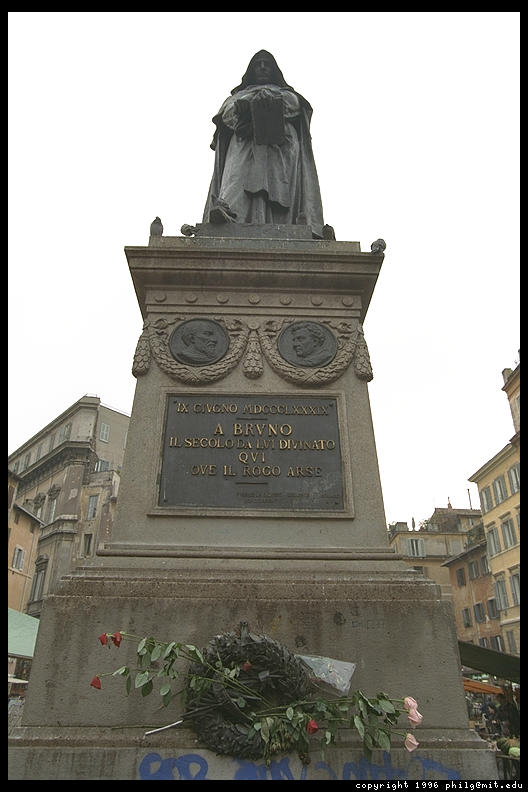
At right, Statue of heroic philosopher Giordano Bruno, at Campo de Fiori, Roma
Religion and pseudo science
Religion is to believe in the unbelievable, to accept as true what is not proven, to render human dignity to powers of fantasy created by those without dignity.

This pseudoscience reducionism - leading to convince public and politicians to consider as diseases those often induced emotional-related states of mind, beliefs, or "insights" which in fact represent just one more "cry of the opressed creature"- was nearly unthinkable in the sixties-seventies. But their success in penetrating the academic Swedish market (in its turn heavily financialy depending of public funds and politically made decisions) has other main explanations than the slimming or re-organization of enterprises and services, or a tuffer occupational climate. I shall develp on this in a next chapter.
Nevertheless, those thesis have been lately regarded in Sweden - thanks to an unfortunate public confusion- even as the "official truth" of otherwise reputed scientific institutions with long empirical traditions such as the Karolinska Institute. I refer here concretely to the discourse propagated from a stress-clinic (stressmottagningen) run by researches which - even if academic associated with the KI - wrongly may have highligthed or may given the impression of an organizational tie between such a private enterprise (stressmottagningen) and the Karolinska Institutet.
This is a situation that Karolinska Institutet - which in fact has nothing to do, I have been told, with that enterprise - should make pristine clear to the Swedish people. Otherwise the prestige of this unique medical university risks of being missused in a massive campaign aimed to accept as medical real in the mind of many, what was from the begining only in the empresarial fantasy of a few.

In fact, those deplorable confusions take much help in the apparently personal opinion certain KI coworkers have on the matter. For instance, one top officer at the Information Department at Karolinska Institutet told me in April 2005 that utbrändhet (the burnout thesis) "it is the official, and not else, at Karolinska Institutet".

In this panorama, as a Swedish citizen, as a scientist, as a human been carrying blood that belong to centuries in the struggle against obscurantism, as a true social liberal, in the name of true equality, true social justice and true freedom, I will here quote the words of my Italian hero Giordano Bruno, a prominent Copernican philosopher and central gestalt of the European Renaissance - burn to death by the Christian Inquisition in 1600:

“It is proof of a base and low mind for one to wish to think with the masses or majority, merely because the majority is the majority. Truth does not change because it is, or is not, believed by a majority of the people.”

Giordano Bruno Burning. Painting by André Durand

---
Important notice. The text of the essay above is subject to adds and changes, and can not be used or reproduced even in parts without the approval of the author. For this purpose, or your comment, you are welcome to email to fdenoli@msn.com

Next:
  • And now to the big question, why Sweden and not the rest?

Wednesday, 2 August 2006

Suicidal Silence. Kasper Tveden Jensen receives award at the European Parliament

Kasper Tveden Jensen received the main award of the contest "Refugees in Europe" at the Prize-giving Ceremony at the European Parliament. KTJ won the First Prize for his article "Suicidal Silence". The contest - on the theme Refugees in Europe - was called upon by the European Council on Refugees and Exiles (ECRE) and the Jesuit Refugee Service (JRS) . I am proud of him!
(see article down below or here).


Writing about Refugees – tävlingen avgjord! From TEMA ASYL. se:

European Council on Refugees and Exiles (ECRE) och Jesuit Refugee Service (JRS) – två viktiga europeiska frivilligorganisationer som arbetar med att förbättra asylsökandes och flyktingars villkor – inbjöd under våren journaliststuderande runt om i EU:s

medlemsstater att delta i en artikeltävling på temat Flyktingar i Europa.

De tre vinnande bidragen har nu utsetts. Samtliga berör i någon mån konsekvenserna av de långa väntetiderna i medlemsstaterna samt den icke-tillvaro som präglar många asylsökandes liv.

Till vinnare utsågs Kasper Tveden Jensen, dansk student som skrivit artikeln ”Suicidal Silence” om det ökande antalet självmordsförsök bland asylsökande i Danmark. I artikeln refereras bland annat till Marcello Ferrada-Noli, professor vid Karolinska institutet i Stockholm, som i närmare tjugo år studerat självmord och psykisk ohälsa bland flyktingar och invandrare i Sverige. De långa väntetiderna bidrar till det ökande antalet självmord och självmordsförsök. I artikeln intervjuas en asylsökande man som väntat över 5 år på uppehållstillstånd i Danmark och under den tiden upprepade gånger försökt begå självmord.


Source: http://www.temaasyl.se/templatesTemaAsyl/TA_Article____5964.asp

Europa Parlament. Foto Kasper Tveden


Tuesday, 1 August 2006

Stressjukdomarnas monopol / The monopoly of stress-related diagnoses in Sweden

30/7. I am back

Det nya svenska stressdyrkandet samt den massiva utbrändhetsupplevelsen är inte någon egentlig epidemi utan en ny religion, med några äkta sjuka och många äkta troende i ett tempel med en och annan företagsam månglare i drift. Profeterna av dessa nya arbetsrelaterade/stressrelaterade modediagnoser har dock inte hitintills kunnat – cirka ett decennium efter den aggressiva lanseringen av sina begrepp i den oförberedda svenska sjukförsäkringsmarknaden – ge en otvivelaktig vetenskaplig bevisning om det orsakssamband som de åberopar.


Stressjukdomarnas monopol

De nya arbetsrelaterade/stressrelaterade modediagnoser samt det rehabiliteringsgeschäft som därtill producerades - av samma forskningsgrupperingar som tidigare lanserade ”diagnosen utbrändhet” i Sverige - har fått en ödeläggande
insyn i DN: s ledarserie av Hanne Kjöller [1]. En huvudpoäng i DN: s analys var att den dyra rehabiliteringen inte har kunnat övertyga om dess effektivitet/nödvändighet, och inte har förankrats i vedertagen vetenskaplig sed. För en angelägen erinran var att samma yrkesmän/forskare som var med att ”fynda” den svenska utbrändheten var de som fått Socialstyrelsens uppdrag att legitimera sina egna diagnostiska kriterier, av allt att bedöma utan opartisk insyn. Vidare, samma grupp hade rekommenderat just de rehabiliteringsåtgärder som i vissa fall motsvarar dessa i sina egenstyrda vinstorienterade rehabiliteringsföretag (DN 17/6). Utbrändhetsetablissemangets reaktion har varit ju underligt dock inte minst hotande för ett seriös vetenskaplig debatt. Jag vill här kommentera den exkluderande/monopoliserande inriktning som - med redskap av oseriösa argument - den debatten till synes vill knuffas till.

I Christina Spjuts inlägg i Läkartidningen [2] och Alexander Perkins i DN [3]) ser man - istället för ett bemötande av sakfrågorna i rehabiliteringskritik - följande ologiskt tillvägagångssätt: a. falacia argumentum ad-hominem, alltså att angripa personens egenskaper i stället för innehållet i sin diskurs. b. den Straw Man uppläggningen, att först hitta på ett fiktivt påstående som motståndaren aldrig hade sagt, och sedan ”försvarar” sig mot det. 3. falacia argmentim ad-baculum (true-in-authority) eller endast en auktoritet kan uttala kunskapssanningen.

Falacia argumentum ad-hominem
Psykiatern Christina Spjut fokusera i sitt inlägg på DN journalisten Hanne Kjöllers personliga erfarenheter och uppger att HK hade skrivit en bok ”som handlar om hur hennes och andras liv förändrats efter en fetmaoperation”, osv., och som inget med den aktuella rehabiliteringsdebatten hade at göra. Vidare i sammanhanget kan man logiskt bekräfta att, oavsett Kjöllers argument i hennes bok Operation: nytt liv, (Brombergs; 2006), ger åberopandet av dessa inga bevis vare sig för eller emot för att samma författare hade i saken rätt när hon skildrade i sin artikelserie de absurda kostnaderna för den rehabiliteringen som exempelvis stressmottagningen förespråkar.

Straw Man
Vidare, Spjut/Perski tillskriver HK centrala påståenden som denna aldrig har sagt, och sedan förstås frikostigt argumenterar ”emot”. Alexander Perski skriver ”stressjukdomar (utmattningssyndrom) finns inte. Bevis – Hanne Kjöller tycker det…Ferrada-Noli tycker det” [4]. Sedan använder sig Perski av det vid flera tillfällen för att ”tillbakavisa påståendet”. Samma sak övar Spjut: HK ”menar att de sjukdomarna (med stressrelaterad diagnos) inte finns” [2].

Sanningen är att HK inledde uttryckligt sitt DN inlägg ”Jag har aldrig påstått att stressjukdomar inte existerar. Jag har ifrågasatt omfattningen, att så många blev sjuka samtidigt, att fenomenet i stort sett bara existerar i en handfull länder med generösa ersättningssystem, samt att de mätbara stressrelaterade sjukdomarna sjunker under samma tid som de mer diffusa stressjukdomarna mångdubblats i Sverige" (DN 4/7). Samma sak har jag tidigare skrivit i flera sammanhang [5-8].

Spjut & Perski angriper även undertecknad och ifrågasätter ad hominem huruvida var befogat att jag uttalade mina åsikter i intervjun vid ledarartikeln ”Lidande är inte lika med sjukdom” (DN, 21/7). Spjut hävdar i det sammanhanget att sjukskrivningsbedömningen åligger som regel ”erfarna distriktsläkare och att de anser att det (diagnosen utmattningssyndrom) är frågan om en sjukdom med en tydlig funktionsstörning” [1]. Faktum däremot är att hos de flesta distriktsläkare är mer patientens önskning än den kliniska bilden det som determinerar sjukskrivningen [9]. Ytterligare, Socialstyrelsen bekräftade nyligen att ”Ofta är det huvudsakligen patientens egen berättelse som ligger till grund för bedömningen av hur sjukdomen påverkar arbetsförmågan” [10].

Om utbrändhet/utmattningsdepression är ”folksjukdomar”. . .
Spjut själv i andra sammanhang sagt ”Det är så många att psykiska sjukdomar nu är folksjukdomar, som depression, bipolär sjukdom, ångest och utmattningsdepression” [11]. Således, antingen är i riket utbrändhet/utmattningsdepression ”folksjukdomar” och då är Spjuts invändningar – mot att en svensk folkhälsoprofessor uttalar sig om svensk folksjukdomar– logiskt absurda. Eller egentligen är dessa inte folksjukdomar alls.

Perski faller också i detta bristande följdriktighet. I KI:s stressmottagnings hemsida förklarar han utförligt att posttraumatiskt stress syndrom (PTSD) är en stressjukdom, för att sedan menar i DN – för den skull att blockera min kritiska uttalande - att vetenskapliga publikationer inom PTSD området inte är att betrakta som stressjukdomsrelaterat! [12].

Vad gäller diskussionen egentligen

Sanningsenligt, de påstådda bestridande ”in persona” kan knappast gälla en annan fråga än att kritikerna har i saken starkt ifrågasatt utbrändhetsforskningens premisser. Om huruvida är dessa något annat en klassisk pseudovetenskap. Om det endast är ”stressen” som har orsakat sjukskrivningarnas ofantliga ökning [5-8]. Och – det till synes känsligast – att jag har offentligt krävt att vetenskapliga bevis ges till allmänheten för de överdrivna påståendena avseende stressjukdomarnas verkliga epidemiologi (bortom antal sjukskrivningar) och orsaksförhållandet. Således, delvis saknas det belägg för att den symtombilden är nödvändigtvist stressrelaterad och inget annat. Delvis – om så vore fallet - att den stressen i sin tur är arbetsrelaterad, endast. Och delvis – om så vore fallet – att de negativa arbetsförhållanden som beskrivs är endast strukturella (typ omorganisationsrelaterade) eller har också att göra med individens egen benägenhet, arbetsideologi och beteende. Detta är det som istället debattörerna ovan borde konfrontera.

Falacia ad baculum
Den fråga som den här debatten har istället tagit nu i dagordning är således ”Vem har rätt, eller är befogad att uttala sig om stressjukdomar”. Men följaktligen Spjuts syllogism (se ovan) skulle endast distriktsläkare vara åtrådda att uttala sig om den sjukskrivningsprocessen. Fast det gör hon själv ändå, som inte heller är distriktsläkare. Ytterligare enligt Spjuts invändning, den som är disputerad i psykiatri skulle inte heller ”få” uttala sig över den forskning som lett till den psykiatrirelaterade diagnos som nu används av distriktsläkare. Fast det gör det hon själv ändå som ej är, mig veterligen, disputerad forskare. Och andra sida, att ”vår kunskap om sjukdomar bygger på det arbetssätt som professor Marie Åsberg och hennes forskningsgrupp har använt vid avgränsning och definiering av utmattningssyndromet” är enligt Spjuts ad baculum argument en självklarhet.

Inte geschäft?
För Aleksander Perski är saken enklare om var man skall precis finna kunskapen om stressrelaterade sjukdomar och dess påföljd: hos honom själv! I sitt svar vid KI:s stressmottagnings hemsida inför Perski “Man kan istället bekanta sig med en ingående introduktion till ämnet i min bok” och marknadsför därefter detaljer om bokförlag, när skall komma ut i disken, etc. [4].

Det nya svenska stressdyrkandet samt den massiva utbrändhetsupplevelsen är inte någon egentlig epidemi utan en ny religion, med några äkta sjuka och många äkta troende i ett tempel med en och annan företagsam månglare i drift. Profeterna av dessa nya arbetsrelaterade/stressrelaterade modediagnoser har dock inte hitintills kunnat – cirka ett decennium efter den aggressiva lanseringen av sina begrepp i den oförberedda svenska sjukförsäkringsmarknaden – ge en otvivelaktig vetenskaplig bevisning om det orsakssamband som de åberopar.

Det råder i det annars så demokratiska Sverige en till synes hård kartell avseende stressjukdomar, om vilka som får delta eller ej vid epidemiologiska eller folkhälsovetenskapliga formuleringar. Den diskrimineringen handlar knappast om ursprung eller yrke, utan om ideologiska, vetenskapliga positioner och en tung prestigefylld olust att konfrontera granskning i saken. Kritiker får aldrig utrymme inom kretsar av självutnämnda. Frågor kvarstår ej svarade, människor förbli, om inte sjuka, sjukskrivna, eller sjukskrivna och lurade, eller bara lurade i väntan på sin tur. Emellertid mår det privata rehabiliteringsgeschäft - med offentliga medel- hur gott som helst i den lilla världen av stressjukdomarnas monopol.

Marcello Ferrada-Noli
Medicine doktor i psykiatri, professor i folkhälsovetenskap inriktning epidemiologi

Referenser
1. Kjöller H. Om Rehabilitering. Artikelserie i DN ledare 17/6 – 4/7 2006
2. Spjut C. Dubbelmoral om sjukskrivningar på Dagens Nyheters ledarsida. Läkartidningen, 2006; 28:2162-3.
3. Perski A. Om Rehabilitering, Inlägg i DN 4/7 2006
4. Perski A. Hanne Kjöller på Dagens Nyheter gillar inte rehabilitering. Stressmottagning.nu.
5. Ferrada-Noli M. Är arbetsrelaterad stress primär orsak till plötslig död?, Läkartidningen. 2000: 97: 6108-10.
6. Ferrada-Noli M. Om tbrändhetens epidemiologiska belägg. Läkartidningen 2001;98:710-5.
7. Ferrada-Noli M. Arbetsrelaterad stress, själv­mord och utmattningsdepressioner, Läkartidningen. 2001;98: 3158-60.
8. Ferrada-Noli M. Kjesarens utbrända kläder. Sociologisk Forskning. 2004:1. 19-26
9. Englund L. (2000) Sick-listing — attitudes and doctors’ prac­tice with special emphasis on sick listing practice in primary health care. Uppsala: Acta Universitatis Upsaliensis.
10. Socialstyrelsen. SOS har granskat sjukskrivningsprocessen. Pressmeddel. 2006-03-15.
11. Socialstyrelsen. Nytt från Socialstyrelsen. Nytt extra från läkarstämman. 2005-11-30.
12. Ferrada-Noli M. Om rehabilitering. Inlägg i DN 7/7 2006.

För en mer utförlig presentation av mina teser om ämnet, läs min artikel publicerade i Dagens Medicin Utmattningssyndrom är en kulturellt betingad diagnos unik för Sverige, Kejsarens utbrända kläder i Sociologisk Forskning (länk) och mitt inlägg i Professors blogg om "Freud, utbrändhet och utmattningsdepression" (länk). Läs även mina artiklar i Läkartidningen om diagnosen utbrändhet/utmattningsdepression, och mina debattartiklar om ämnet i http://ferradanoli.wordpress.com/burnout . Mina vetenskapliga artiklar om posttraumatiskt stressyndrom i
http://ferradanoli.wordpress.com/articles