Sunday, 16 June 2013

Perfidious move against WikiLeaks in leading Swedish MSM – At the anniversary of Julian Assange’s political asylum

DN 16 June 2013, at the anniversary of Julian Assange political asylum, confined at the Ecuador Embassy by Sweden's design:

"Today’s whistle-blowers choose for their leaks rather other sites than a crippled WikiLeaks"

For such conclusion the leading Swedish paper is quoting direct declarations done to to DN by "WikiLeaks' contact-person in Sweden" Prof. Christian Christensen, and also by the  known anti-Assange journalist David Leight. 

And regarding Assange, who DN reports is “legally suspected of rape”, “there is no solution at sight whatsoever” (Ingen lösning i sikte för Assange), says DN. These stabbings on the back of truth by Sweden establishment’s MSM  are done in the very moments that Ecuador’s Foreign Minister Patiño starting the talks with UK authorities in London for just that purpose - to find a solution to the deadlock produced BY SWEDEN with its prestige-bound negative of interrogating Assange in London. Further, the UK autorities as reported by BBC quoting a Foreign Office spokesman, "remain committed to seeking a diplomatic solution to this situation". The Swedish media campaign appears as double fold unethical, for neither DN dare to publish the complete reportage on-line for the general public, avoiding confronting international rebuttal to the inaccuracies of Hall, Christiansen and Leigh. Professors blogg reveals however the MSM plot here.
 Analysis by Prof. Marcello Ferrada de Noli

DNcover Assange16-2-13

DN First-page 16 June 2013: "Deadlock remains in the case Assange"

 Leading newspaper Dagens Nyheter (DN) surprises today the Swedish public with a first-page article on WikiLeaks, the whereabouts of contemporary whistleblowing which now “neglect WikiLeaks” to opting for classical newspapers which can now offer services and security level to the whistle-blowers that a "crippled" WikiLeaks is not any longer in position to offer. The reportage, composed by various articles in the main by foreign correspondent Thomas Hall (previously criticized in Professors blogg for his ostensible pro US-Army bias in the Swedish reporting on the NATO civil-killings in Afghanistan), and with corresponding political reflexions around the first year of Julian Assange at the Embassy of Ecuador in London.

''Leaks choses other than WL''

DN article: "Whitleblowers select other ways than WikiLeaks"

Journalist David Leight:
"We have not been in contact with WikiLeaks since three years. WikiLeaks has been since then practically out of the game"

Christian Christensen, media professor at Stockholm University, and which according to the DN reportage is "given by the WikiLeaks (official) site as contact-person in Sweden" [http://wikileaks.org/Press.html#wsf]:

"WikiLeaks was before the only organization that could guarantee anonymity and at the same time offer large spreading through cooperation with various newspapers. Today there are several alternatives for leaks (whistleblowers) in order to reach (the public) with their material"

Professors blogg comment: The authors above are not considering the true difference between the materials released by WikiLeaks and those published, for instance currently, by the MSM. These differences are mainly in terms of:

a) Quality of the material (in the sense of originality of the materials - nearly unfiltered for reasons of protecting identities, etc., instead of  being redaction "reportages" based in information from those materials)
b) Extension of the materials. The production available to the public at the WL sites equates – to the best of my knowledge – the material at disposition of WikiLeaks.
c) Free availability (public access) of the material beyond the readers or subscribers of the corporative MSM
d) Most important ethical issue of all: WikiLeaks is NOT an instrument of the power they exercise control upon. WikiLeaks exposes a system of  power-abuses in which many MSM have been a part of it.
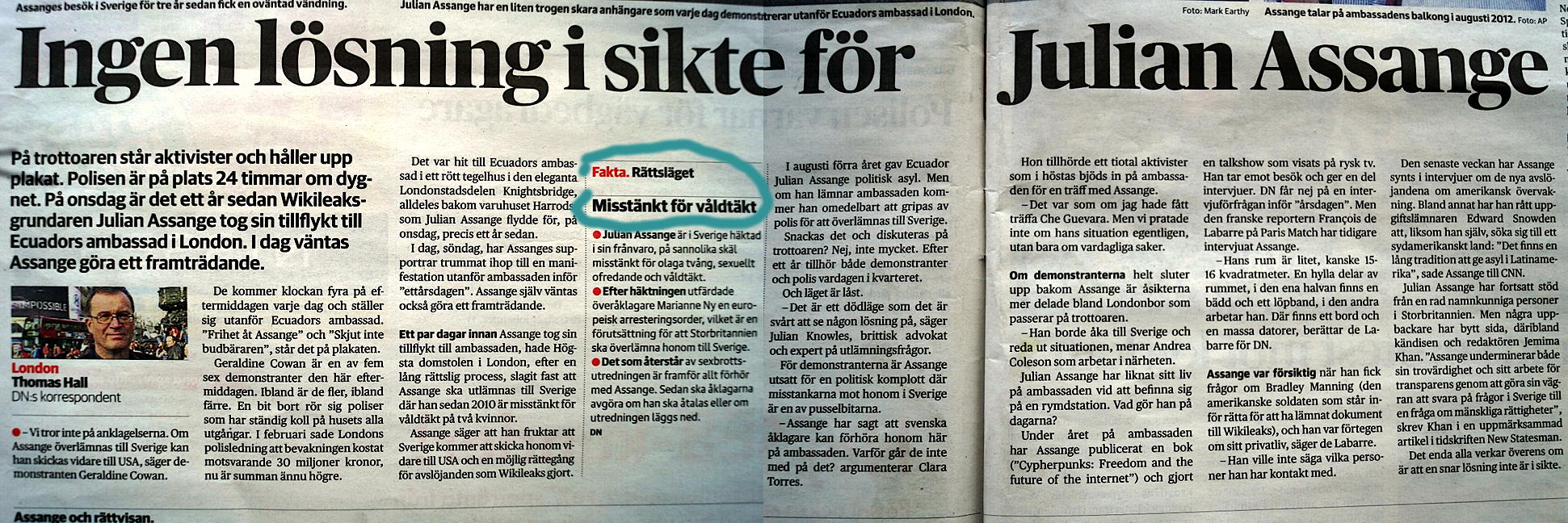
mistänktfv
Article "There is no solution at sight whatsoever”
Encircled text in green-blue:

"The facts, juridically: Suspected of Rape"

My comment about the "deadlock" at the Embassy ("There is no solution at sight whatsoever”)
Nominally, the deadlock at the Embassy of Ecuador in London has been attributed to the negative of the Swedish authorities to conduct an interrogation with Julian Assange in London, directly in situ or by video-link - both procedures contemplated as standard in the Swedish legal praxis. However, the explicit political thesis presented in Professors blogg has been another. We have called the "Stalling hypothesis" and refers to:


As far the “accusations-item” is concerned, Sweden has at-large demonstrated it is NOT interested in ending the legal case. The only interest Sweden has demonstrated is in trying to obtain the extradition  – by any means possible – of Assange to Sweden, where Assange would be kept incommunicado-status behind bars as per standard legal procedure in Sweden.  The extradited-prisoner status of Assange (the status he would have if taken prisoner to Sweden) enables other “juridical” possibilities for Sweden, respective to USA, that were not accessible at the time he would have been interrogated by the Swedish prosecutor when he was free in Sweden. This situation may be one explanation why Assange was led to understand he was “free to travel”.
The Swedish legal extradition process against Assange, and the Swedish legal process regarding the accusation “by the two women” against Assange, are in the main two different things – and only euphemistically connected. Those two different things have wrongly been mixed up in the discussions around the “juridical case”. The synthesis of this dialectics confirms conclusively that the Swedish “legal” case against Assange is solely the political case of USA against WikiLeaks.
The known homogeneity or “consensus” between the Swedish political parties appears most visible in a) matters of foreign policy, b) issues of  “National security”, or c) any topic that might compromise the prestige or trademarks of Sweden abroad. And we find the Assange case implicated by the Swedish authorities in those three items altogether.

From Professors blogg article Timing the processes

-- Delaying Assange extradition-process for timing with process in the U.S.  On the possible reasons for the neglected interrogation of Julian Assange and the verdict delays. On WikiLeaks  and Democracy. Excerpts of the RT Interview in Stockholm and excerpts regarding the "protracting theses"
"In the U.S., the preparations for these trials are seeking a connection between WikiLeaks and Bradley Manning in terms of making Julian Assange accountable; is that what they are apparently looking after. And for that they need time. They need to prepare these materials. And for that, of course, it is highly convenient to keep Assange under arrest – and under the threat of the prospective of bring him here to Sweden, where he later he might be subject to an extradition petition."
In the RT interview 'MSM blacks Assange as US seeks Manning link', gives a further rationale for the "protracted" legal process is discussed. The thesis on the protracted Swedish process aimed to benefit a timing with the U.S. processes against WikiLeaks and its founder Julian Assange, finds support in some items at the time line "United States v. Manning, Assange, WikiLeaks, and the Press" authored by Alexa D. O'Brien. Some issues in this inteview are referred in the RT article US needs Assange under arrest ‘while seeking Manning link’
Excerpt:

RT -Julian Assange, hailed as a hero for leaking information through his site WikiLeaks, is facing an uncertain future. Swedish authorities want to question him in relation to sexual assault allegations; and some politicians in the U.S. want to extradite him there to stand trial for leaking tens of thousands of secret US government documents. Here discussing the on-going discussion surrounding Julian Assange is Professor Marcello Vittorio Ferrada de Noli. Professor, thank you for joining me. Moving straight on to Julian Assange, how do you put the balance: Julian Assange is facing justice? Or this is a political motivated assault on Julian Assange

Answer
Well, I have my doubts about that (facing justice). Because even considering the particularities of the Swedish legal system, Sweden would have also the possibilities of for instance questioning Assange by other means; by the phone, or by means of the Swedish Embassy in London, and so one and so forth. I would be more inclined to think that here is a political reason why this process has been put forward in he fashion it has been. I would believe that the reason for the arrest order issued by Sweden is to get WikiLeaks founder Julian Assange here into Swedish territory. By being here in Swedish territory he would be then subject to further extradition process in this case from Sweden to the U.S. I would believe that the reason of this (mimicking quotation marks) “legal” situation is more political. There is another strategy, in my opinion, behind the all thing.

“Operation stalling” 
The external-caused, protracted asphyxiation process of WikiLeaks (economically, politically, and in the organization structure) apparently corresponds to a psychological-warfare design. I called it “Operation stalling" [See "Swedish psychological warfare against Wikileaks and Assange"], as it aims appears to be the procrastination of the "legal" process and corresponding verdicts of extradition and the like.
While the Swedish part had ample possibilities of arrange the interrogation of Julian Assange already in Sweden, or even later while Assange was under police custody or arrest in London, what we could witnessed is instead an unnecessary or "constructed" delay. This procrastination seemingly was a sine-qua-non element in the strategy of asphyxiate Wikileaks economically; for the longer the process went on, the more aggravating turned the funding situation cause by the Visa/Mastercard transaction stop.

The strategically political damage to WikiLeaks was in this design a) partly to immobilize, delay or obstruct the analyses of materials and editing, of for instance the so called cables-production, b) partly to discourage the collaborative material would to be sent from the part of the public to Wikileaks, based in the notion that these individuals would wait until Wikileaks founder would be  “clear” of any wrongdoing.
The economic blockade aimed concomitantly to asphyxiate Wikileaks also politically, as its political base and collaborative cadres, all of them engaged only altruistically and ad-honorem, neither could endure such long period, almost a year now. This situation also affects WikiLeaks organizational functioning, as the longer the time the undefined process persists, the more expensive the costs, and ultimately the totally draining of such funds. Actually, this was pointed out by Julian Assange long time ago, when in one of his appearance’s outside the court in the previous hearings compared the enormous resources put up in this legal process by Sweden, Britain or elsewhere, in contrast with the hyper limited resources at his disposal.


Wednesday, 12 June 2013

No server is secure. The list of digital whistle-blowers is getting longer – By Rodrigo Ferrada Stoehrel

"Hammond and Anonymous have shown, albeit in his own way, that to produce change we must fight for ourselves. No one else will do it for us."
"It is said that knowledge is power, but it is power that decides what is knowledge. That is what the fight is about." Rodrigo Ferrada Stoehrel

The Swedish newspaper Aftonbladet published today (11 June 2013) "No server is secure. The list of digital whistle-blowers is getting longer" [Ingen server är säker. Listan av digitala whistleblowers blir allt längre], an article authored by Rodrigo Ferrada Stoehrel, PhD student in Media and Communication Sciences, Umeå University. Here below an (unofficial) translation by Professors blogg of the article based on the Aftonbladet published version.

Rodrigo article 

No server is secure

By Rodrigo Ferrada Stoehrel

The trial against Bradley Manning continues unabated; and Edward Snowden (the NSA-leak) revealed yesterday, worldwide, details on his whereabouts. The list of digital whistle-blowers is getting longer. Two weeks ago, the man who hacked the security firm Stratfor, and sent the information to Wikileaks, was brought to trial in a lawsuit that raised questions about who really monitors whom in the modern information war -- and in which the balance of power is far from obvious.

Criminal or political prisoner? terrorist or freedom fighter?

In a legal sense, Jeremy Hammond’s hacking is held a criminal activity regardless of the intentions he had. In political meaning, Hammonds and other activists like him are hacking in a world of economic and state secrets - and revealed them to the public.

On May 28, the trial in New York against cyber activist Jeremy Hammonds was one of the main discussions on Twitter. It was discussed whether the potential penalty of ten years was fair or disproportionate, and on the possible causes of the long sentence. It was discussed whether the American judicial system is trying to set an example against hacking, or it just an expression of fear. Suddenly disclosures of confidential political-economic information challenges the democracy’s image, which has been painted for long, and relatively, unhindered.

The 28-year-old Hammond was arrested in 2012 along with four other activist accused to hacking into the private U.S. security and intelligence firm Stratfor (Strategic Forecasting Inc.). In December 2011, they had leaked five million emails to Wikileaks, which in turn spread the information to the media worldwide. Hammond was nicknamed "Robin Hood" because he also must have stolen credit card information (not encrypted, according to himself) from Stratfor and donated nearly 700,000 dollars to various aid organizations. A sum that is now completely returned to the company.

After seizing part of the documents via Wikileaks, both the UK's The Guardian and U.S. Rolling Stone Magazine reported (27 and 28 February, 2012) about how Stratfor secretly collaborated with the U.S. Department of Homeland Security (Department of Homeland Security). The goal was to develop strategies for civilian domestic surveillance.

The (WikiLeaks’) Stratfor-leak, and Edward Snowden's revelations about the U.S. government-led mass surveillance, allows us to peer into an ever darker shadow-world of both government and private companies spying on their own people. A process which is incompatible with democratic values, according to Abi Hassen, a lawyer and coordinator of the U.S. National Lawyers Guild. As Hassen declared to the site Sparrow Media: "Today's trial should be instead the springboard for an investigation of Stratfor, and not an occasion used to sentence a young man to ten years in prison for political activism."

It is in many ways ironic that Hammond can get ten years for hacking, while the young- rapists from Steubenville High School in the USA got one, respectively two, years in juvenile detention-institutions. The youngsters were arrested after Anonymous - the political movement that has been associated to Hammond and the hacker collective LulzSec - leaked video evidence.

On Twitter, the debate has also centred on the New York judge Loretta Preska could be accused of bias. This is because the revelations indicating that her husband's law-firm Cahill - one of Stratfor’s customers – was found in the material that was hacked. Yet others maintain that Hammond’s hacking should be regarded as idealistic political activity -- civil disobedience.
The debate in Twitter has also to do about enabling an alternative knowledge form, about an attempt to approach the truth by circumvolving the democratic facade  - and to publish it. We have never been in greater need of information and corporation-transparency.
From this perspective, the activities by Hammond and Anonymous are something more than a classical computer hacking.
No server can hide information in an absolutely safe way. And this has a symbolic value. No civilian group can ever match the institutional power-infrastructure in what war technology is concerned. However, in a cyber or information-war those terms change, at least theoretically. It is here where the hacker-culture as a political movement comes into play.
As globalization expands, also increases the risk of concentration of the political and economic power. Ensuing this logic, the neo-liberal version of democracy will not change.
Nor shall economic and political inequalities be balanced. None of the beneficiaries of the current power structure will take up the fight for the oppressed, which comprise the global population majority.
Hammond and Anonymous have shown, albeit in his own way, that to produce change we must fight for ourselves. No one else will do it for us. It is said that knowledge is power, but it is power that decides what is knowledge.
That is what the fight is about.

Rodrigo Ferrada Stoehrel
PhD student in Media and Communication Sciences, Umeå University, Sweden

Monday, 8 April 2013

Government-sponsored presentation of Supreme Court judge in Australia increased doubts on Swedish legal system

Although international media widely reported that “Stefan Lindskog was critical of the Swedish criminal investigation”, his public lecture in Adelaide - sponsored by the Swedish Foreign Office - was in the main an attempt to recover trust in the Swedish management of the Assange case. He said it is feasible to proceed with the interrogation Assange in London, and also while acknowledging that illegal extraditions to the US by the government occurred in Sweden, he declared he has the “hope” it will not be the case with Julian Assange. The risk for the extradition of Julian Assange to the US continues unabated.


by Marcello Ferrada de Noli

After the PR-event in Adelaide sponsored by the Swedish Ministry of Foreign Affairs, AAP ran a cable with the headline “Assange safe from extradition in Sweden, judge suggests[1]. But this “breaking news” - a direct challenge to Mr. Assange’s claim on the risk he would face if sent to Sweden – it was hardly a fair interpretation of Judge Lindskog’s publicized speech at Adelaide Law School. The PR-coup, which was media-dramaturgy reinforced with a cable purporting Lindskog was critical to the Swedish procedures (published by a variety of media, from Stars & Stripes to Aljazeera) [2], is sourced in an ambiguous text on the extradition issue prepared in advance and read by Justice Stefan Lindskog, for which presentation a live stream and video was made.


However, the actual declarations of Lindskog in the panel that ensued – where he acknowledges that illegal extraditions to the US ordered by the government have occurred in Sweden, and that he has the “hope” it will not be the case Assange - remained unknown to the international public and journalists, for it was not sent live nor video-recorded or shared by the sponsors of the event.

Nevertheless, I have received partly a copy of the audio recording sent to me personally by Australian documentary-maker Catherine Vogan, who has reviewed materials directly recorded by the public in Adelaide[3], and partly details sent to me by Ken Sievers[4], who was attending the event and made the first question to Judge Lindskog.

This is my transcription of the audio recording:

Question at the end of the lecture (Ken Sievers)[5]: “I will put this question to Stefan Lindskog: Isn’t it quite possible that, it could just happen that Julian Assange could be put on a plane and sent off to the US just like those two poor Egyptians? It is possible isn’t it? Because these states, whatever lovely laws they have, they cannot always follow their own laws, isn’t correct?”

Lindskog: “Well, it is correct, . . . but that case it did not pass the Supreme Court. It was wrong all the way. I think that this case, if it comes to extradition, it will pass the Supreme Court, and hopefully it will not be such . . .”

The  lecture

Justice Stefan Lindskog’s lecture in Adelaide had little, if anything, to do with the announced title “The Assange Affair: freedom of speech and freedom of information, a global perspective”; he elaborated much on the details of the sexual-offences allegations against Mr. Assange, while playing down the criticism towards the Swedish legal system with have prevailed around the case. Consequently, and regardless the true and serious motivations of Justice Lindskog, his lecture has been instrumented to sustain the official posture of the Foreign Ministry Sweden, wishing to put forward that a) the case has no political implication and that it is based only on an investigation of “sexual offences”; b) onward extradition to US is not a risk and, therefore, Ecuador had no reason to grant Assange political asylum; c) Assange should therefore be sent to Sweden as prisoner.

However, the official theses crashed at multiple occasions during the presentation, and particularly during the discussions ensuing: Why would the government of Sweden persist in bringing Mr. Assange as prisoner to Sweden when simply interrogating him in London could resolve the deadlock? Corollary, why has Foreign Minister Bildt declared that such procedure is not juridical possible ("not permitted")? [6]

The chairman of Sweden’s Supreme Court chapter 2, Stefan Lindskog, stated however in Adelaide:

“I would like to comment upon the possibility of the prosecutor to go to London. It is possible that the prosecutor could travel to London and interrogate him there. I have no answer to the question why that hasn’t happened.”[7]

Justice Lindskog omitted thou key issues on the international criticism of the Swedish legal regarding managment of the Assange case

In his otherwise promotion of the Swedish legal system, Lindskog referred to a few items touched upon in the international criticism, but he failed to address the real issues that have characterized this criticism in the context of the “Assange Affair”. Remarkably, he for instance never developed on the interferences in the legal process by PM Reinfeldt and other prominent politicians, or on the compact Trial by media – both aspects specifically mentioned by Judge Howard Riddle in the London Court verdict of February 2011. Namely, Judge Riddle concluded, “there is a negative publicity” on Assange in Sweden, and he includes statements by PM Fredrik Reidfeldt". [8]
Lindskog dedicated most of his lecturing time to describing detail after detail of how the women met Assange and of the intimate behaviour as reported by the accusers – details already known by the public through the leaked PM of the interrogations published in Internet. He referred to leaks made by the police, and he said that details of the leakages would not be known because “perhaps” no investigation has been done. And he developed long into the subject of restrictions on investigating leaks due to Sweden’s laws protecting sources, the so-called “source privilege”.

However, that is hardly the kind of “leakages” which has severely placed the Swedish legal system in mistrust. Lindskog did not say a word about criticism on the prosecutors involved in the case, one of which (the on-call prosecutor, on the 20 of August 2010) has – against accepted procedures - given to newspaper Expressen information on the identity, name, of Mr. Assange, together with details of the accusations and which resulted in Expressen famous smear-heading “Assange arrested in absentia for rape”[9]. This scandalous violation of the human rights of Mr Assange, who should be considered innocent unless otherwise judged in a court of law and who has not even been charged with any crime, is a breach of Sweden's own legal praxis perpetrated by a Swedish prosecutor managing the case Assange in the Swedish legal system. The prosecutor is known by name and position. Thus, what she did is not a secret but it is illegal and it was not sanctioned.

Those are the type of leaks in the Assange affair that have occasioned severe criticism and damaged the prestige of the Swedish legal system. And those behaviours could hardly be categorized under “source privilege”. In addition, Professor Lindskog even suggested that the world should take seriously as a “forerunner” Sweden’s example on the praxis of protecting “source privilege”.


Swedish legal system, no different?

Lindskog declared, “Now, what about the hard Swedish laws on sex crimes? In Sweden, as in most developed countries, the attitude towards what should be regarded as a sexual crime has changed dramatically over the last years. “ Well, that is hardly controversial. However, the problem that Judge Lindskog failed to address and that has been of great concern, is that the prosecutor responsible of the case, the prosecutor that decided to reopen the case, and lawyers in the law-firm instigating the reopening of the case, all of them have had participation in government-appointed committees in the reviewing and enhancing of the legislation-items about which the Assange case has been declared “a symbol” or “pilot-case”. Such positions have been put forward from clear ideological perspectives in the political struggle to further radicalize the Swedish legislation on sexual offences.[10]

He went on to state that the Swedish legal system is no different than that of most of European countries; although he admitted one or two “differences” such as the absence of the institution of Jury. But to say that the legal system of Sweden is not different is inaccurate. Markedly differences, such as the institution of lay-judges (the political appointed judges)[11], were neglected by Justice Lindskog. He only said about this unique Swedish judicial construction, “And we have Lay judges but they have mild influence on the outcome”.

The above would qualify for Swedish understatement of the year in juridical maters. In fact, since the very beginning of the Sweden Versus Assange affair, and the international criticism that erupted, much has been focused in this issue. The topic “lay-judges” has been a highly debatable issue also in Sweden both within the ranks of professionals in the legal system[12] or in Sweden-based human-rights blogs[13].

With regard to further differences, Judge Lindskog certainly knows that the prosecutors in Sweden have greater power than in peer institutions in Europe. Even the number of prosecutors in Sweden is unusually high. Sweden has more prosecutors per capita than Germany, Finland, Switzerland and Norway, and over the double of prosecutors per capita than for instance France, Italy, or Spain.

The list of peculiarities in the Swedish legal system is definitely longer than the referred above. And this is hardly a discussion of purely academic value. It can have consequences in the managing of criminal investigations. In this context, it should be added that in spite of a good overall appraisal of the Swedish legal system, the WJP Rule of Law Index rated Sweden No. 30 regarding Sub-factor 8 “Criminal Investigation System Effective” in the international index of 2012 – long after Botswana, Romania and Senegal! First positions in that ranking occupied by Denmark (No. 1) and Finland (No. 2). Sweden may still have a good and democratic legal system, but if we are talking about differences between European countries regarding aspects of the legal systems, we could hardly neglect whether there is substantial variances in the effectiveness of criminal investigations.

Extradition issues

Many things what Lindskog said in Adelaide were true or partly true. But some things were not accurate, and definitely, he did not tell the all truth known to him as the highest positioned member of the Justice system. Moreover, the issues he omitted do, in fact, constitute the international criticism towards the Swedish legal system regarding the managing of the case Assange. As a result, instead of an effective “damage control” operation on behalf of the Swedish legal system, the government-sponsored event in Adelaide resulted in the opposite: the distrust may have increased.

Together with emphasizing aspects of the investigation for sexual offences, Lindskog played down the issue of holding or facilitating extradition to the US, and he read from his script what sounded like rather cryptically formulated statements. For instance, he used “shall not be” extradited according to a certain legislation (indicating using of imperative form, of what it is supposed to happen according to that legislation). Thus, he left other options on the table while providing the media the opportunity to promote such equivocal “conclusions” such as the one referred above on that “Assange safe from extradition in Sweden, judge suggests[14], or the dispatch “Swedish judge says Assange has little to fear”.[15]

Other media, like in Italy La Repubblica, had a more cautious approach and, based in the video from the lecture in Adelaide, reported that "the extradition cannot be applicable in the case of Assange".[16]

In fact, Lindskog also referred to other legislation thy may prevail in the case, and to other possibilities. We can trust legislation, he referred elliptically, but can we trust governments? He nonetheless omitted to say clearly during his talk that, ultimately, it is the Swedish government that would decide on a controversial or sensitive extradition matter. As I demonstrated in my previous article in Newsmill, political extraditions in Sweden have little to do with laws or judges. In Sweden, one thing is the written law, but what is fact according to the historical praxis is often altogether different.

Moreover, Justice Stefan Lindskog uttered the important statement (quoted in the beginning of this text) in answering a question during the panel, where he clearly admits that extradition to the US can be possible even outside the interpretation or use of the law. The risk for the extradition of Julian Assange to the US continues unabated.

Finally – and to the best of my recall –Lindskog never talked about Sweden-US temporary surrender agreement, which is a risk to M. Assange that has been widely discussed in international condemnation of Sweden. Other aspects relevant to the above, and not touched upon by Justice Lindskog on the theme of political extraditions, are taken up in the referred the above referred Newsmill article “Mismanagement of the Assange case devastating to Sweden’s international reputation“.

Concluding: 

Minister Carl Bildt incorrectly claimed that the Sweden government couldn’t make a guarantee that Assange won't be extradited because the decision rests with the judiciary. This is now proven as flagrantly inaccurate. The final decision for approving an extradition rests with the government. The question that remains is, why the Swedish government persist in prolonging this case, whose deadlock could otherwise easily be ending by either:
  1. Giving guarantee from the part of the government that Mr. Assange will not forward extradited or to US authorities
  2.  
  3. Performing the interrogation with Mr. Assange in London
In other words, what political forces, which governments, which processes are the main beneficiaries of this clearly artificially prolonging of the case? They have

[3] Catherine Vogan has published part of the material used here on the Australia-based site THING2THING.
[4] “I asked the first question. I started by reminding people of the fate of Ahmed Agiza and Muhammad Alzery in 2001.  I stated that the Swedish state had obviously done something wrong because they later paid compensation to the men. I said my question was not to do with the law per se. I also referred to his remarks to the effect that states are not perfect beings; they are "not always good". So in this case the (Swedish) state had done something it should not have done but it did it anyway.” Source: personal communication from Ken Sievers, 7/4 2013
[5] This was the first question addressed to Justice Lindskog
[6] See lawyer Jennifer Robinson declarations in Expressen - Almedalen, article "Carl Bildts besked till Julian Assange i Visby" by Annie Reuterskjöld 6/7 2012
[8] “But Ridley also says that there is “significant negative publicity” on Assange in Sweden, and he includes statements by PM Fredrik Reidfeldt” (“Men Riddle säger också att det finns ”betydande negativt publicitet” om Assange i Sverige, och att det inkluderar uttalanden från statsminister Fredrik Reinfeldt. “) In: Karin Thurfjell, “Domare: Hurtig försöker vilseleda domstolen”, Svd 24/2 2011
[9] See Expressen's article "Assange being arrested in absentia - for rape" by Diamant Salihu and Niklas Svensson; and Newsmill article "Assange stopped witch-hunt aganst Julian Assange", by Olle Andersson
[12] See for instance the DN-debate article "The lay judges erodes confidence in the courts" (Nämndemännen urholkar förtroendet för domstolar”, DN, 19/3 2011) authored by Professor Claes Sandgren, former Dean at Stockholm University Law School, ambassador and member the International Commission of Jurists in Ginevra
[14] APP, The Age, 4/4 2013
[15] ABC Radio Australia 4/4 2013
[16]la etradizione no se puo aplicare in el caso de Assange”. In Giudice svedese: ''Assange ha agito a beneficio umanità''. La Repubblica, 4/4 2013
_______________________
Other valuable links  which Cathy Vogan provided me:

JULIAN BURNSIDE QC: https://vimeo.com/63258441
PROFESSOR GEORGE WILLIAMS: https://vimeo.com/63470904
---
I thank @treisiroon for proofreading

Wednesday, 3 April 2013

Contesting announcements of Sweden’s Justice Stefan Lindskog – lecture on Assange at Adelaide University

By Prof. Marcello Ferrada de Noli
[originally  published in Newsmill, 3 April 2013]


The University of Adelaide’s Law School, Australia, has publicly announced that Justice Stefan Lindskog “Chairman of the Supreme Court of Sweden, Sweden's highest Court of Appeal will deliver a keynote public lecture on the Assange affair, and freedom of speech, from the Swedish perspective. As one of Sweden's most eminent jurists he is uniquely able to provide an authoritative view of the Assange affair.“

swe embassy sponsoring

It is of course not completely known what will be the final content of his address at Adelaide. But the fact that the event has been announced as officially sponsored “in association with the Embassy of Sweden” clearly indicates a new interference by the Swedish government in the juridical case.

Stefan Lindskog has himself declared in Financial Review that his public note will be dealing with such political issues (i.e. human rights, freedom of expression) “from the Swedish perspective” and specifically relating to the case Assange. Considering that this is a case under investigation and by nominally lower ranks in the Swedish legal system; and that they have manifested they are studying the possibility of indictment (Assange HAS NOT been charged), the public statements of a chairman of the Supreme Court prior to that formal decision from the prosecutors is highly noteworthy.

It must be noted that Stefan Lindskog is himself of the opinion - as referred by Justice Marianne Lundius – that “the role of (Supreme Court) judges, by a matter of principle, is not compatible with the role of engaging themselves in criminal investigations”. This was said in the context of declarations with regard to the investigation of Olof Palme assassination.

Since the instigation of this case against Mr. Assange, Swedish media has worked as an arm of the Swedish State and perpetrated a Trial by Media, which has been widely marked by hearsay, misinformation, and attempted character assassination of Mr. Assange (see my article in Newsmill, English text, “(Swedish) Media reports on Assange are untruthful and identical”). The fact that the chairman of the highest court in Sweden is being sponsored by the Embassy of Sweden in Australia to opine publicly on a case that may come before his court has been widely commented in social media reaching millions of international viewers and participants, yet neither the Swedish media nor the Swedish authorities have mentioned the issue at all to the Swedish public. The silence is deafening.

I recently delivered an invited lecture on human rights at The University of Örebro, about some similar topics that are to be taken up by Stefan Lindskog in Adelaide. In the presentation I listed facts that seriously contradict the message of the “Swedish law and order” abiding principle that Justice Stefan Lindskog is generally conveying in his column “Julian Assange: Swedish Justice”.

In the first place, the Prime Minister of Sweden, followed by prominent political leaders and journalists, has made declarations on behalf of the accusers of Assange, directly intervening in the process, which, as mentioned above, is still in the pre-investigation stage under one prosecutor.

Secondly, this prosecutor unilaterally decided to reopen the “case against Assange” at the initiative of the law firm run by the Swedish politicians Thomas Bodström (former Minister of Justice) and Claes Borgström (former Ombudsman on gender issues). They, together with the prosecutor of the case, Marianne Ny, have been directly involved in government appointed committees studying the enhancement of the sexual-offences legislation in Sweden. However, when the prosecutor was reported for alleged irregularities in the case Assange, this was rapidly dismissed on technical grounds by the “Swedish legal system”.

Thirdly, in Sweden, “according to the law”, it is forbidden for prosecutors to reveal the identity or details in cases of sensitive accusations like the one against Assange. Once more I remind that these are only allegations under investigation, not charges, no trial. However, one prosecutor revealed the name of Julian Assange and details of the accusations directly to the tabloid Expressen, which ran a front page smear article on the basis of uninvestigated allegations. The prosecutor was reported by human right organizations, but the Swedish legal system dismissed the case against the prosecutor on technicalities.

Then we have the facts that are better known in the international community about the interrogation-issue of Mr. Assange in London, a procedure that has been flatly denied, without any juridical grounds, by the Swedish prosecutors. Swedish prosecutors are fully able to go abroad to pursue cases, including questioning. In fact, Swedish prosecutors and judges travelled during 2012 all the way to Africa to put up a hearing in situ (in Africa) regarding allegations against a person living in Sweden.

The Swedish Ministry of Foreign Affairs, in an initiative revealed after the visit of Foreign Minister Carl Bildt to Australia, is behind the unethical, opportunistic sponsoring of Justice Stefan Lindskog, of the Supreme Court, traveling all the way to Australia in a bid to counter the international embarrassment Sweden has suffered through its own actions in the case Assange. They have chosen this route instead of ending the embarrassment by ethically (and totally according to the Swedish law praxis) conducting the interrogation of Assange in London, which is just a couple hours’ flight from Stockholm. It is left to see whether Associate Professor Stefan Lindskog will have an independent stance in spite of the official embassy sponsoring, and whether such stance would or not represent prospective rulings of the Supreme Court.

Let us make clear that Mr. Assange, through his legal representatives, has stated that it is his wish to clear the Sweden case and that he would come to Sweden if they guarantee no onward extradition to the United States. Indeed, Ecuador’s decision for granting Mr. Assange asylum is based in part on Sweden’s refusal to grant such assurances. In the case that Mr. Assange would face extradition from Sweden, it is the Supreme Court, chaired by Justice Stefan Lindskog, who would decide the legality of any extradition. If extradition is ruled legal, then it would be up to the government to decide whether to allow extradition.  Nevertheless, there are cases in which the Swedish government has facilitated extrajudicial extraditions at the behest of the United States. These are the cases of “extraordinary renditions” authorized by the Justice Ministry and of the Foreign Office of Sweden. One of these cases was exposed and occasioned the sanctions from the part of the UN against Sweden, for serious violations against the Absolute Ban on Torture, which Sweden had signed.

Justice Lindskog has announced he will be arguing around the extradition-issue of Assange to the US. For that, he has prepared a long list of law-paragraphs that he presented in Financial Review. Let me just remind that in contrast with the legal wording of documents signed by Sweden on matters of extradition, we have the praxis of the Swedish government. These facts cannot possibly be washed away with a fancy lecture or a pseudo panel of arranged questions and deceptive responses.

Sweden is not a neutral country. Rather, it is now fully committed to Intelligence and military operations led by the US armed forces
Sweden participated actively with logistical and engineering aid in the US bombardment of Iraq. Sweden participated in the military surveillance of the bombardments of Libya, an initiative from the government, which received the support of all the Swedish established political parties, from the conservatives (Moderater) to the Left Party (Vänster). Sweden is actively participating, under the command of US, in the military occupation of Afghanistan.
 
In connection to the above, WikiLeaks has exposed that the Swedish surveillance-legislation (FRA-lagen) which, in spite of great controversy, the government put forward in 2008, was a “made-to-order-job” directly requested by the US government. Most recently, a legislation initiative was put forth by the Swedish government aiming to protect the interests of the countries with which Sweden has on-going collaboration. The proposed legislation is also known as the anti-WikiLeaks legislation.

Whatever the concrete formulation of an indictment of Assange in the US, it will be inevitably related to allegations of whistleblowing military secrets, etc. Sweden, as a close military partner with the US, has largely complied with and even collaborated on matters of renditions of individuals regarded as enemies of the US. Swedish reporters have revealed very recently, with sources independent of WikiLeaks, that Minister Carl Bildt has been an informant of the US government for decades. These episodes have irritated his old political partners of previous government coalitions, who claim they did not know, and that they do not approve of Bildt’s position as it has been revealed. However, it is none other than Carl Bildt who is deciding extradition and rendition matters in Sweden. Let’s recall that the recent rendition to the US of Swedes in Ethiopia, was done with the knowledge of the Swedish Ministry of Foreign Affairs, and in spite that Swedish prosecutors have cleared these individuals from suspicions of being terrorists.

The words printed in the Swedish law books tell that agreements with foreign powers compromising sovereignty-issues should be known and approved by the Swedish Parliament. The current praxis has been, however, that military intelligence endeavours such as gathering of information about Swedish nationals is nowadays controlled by agreements of officials of the Justice Ministry and of the Foreign Office of Sweden with US government Intelligence organizations. This, totally unknown by the Swedish Parliament, is one of the items exposed by WikiLeaks. A prominent journalist from Expressen wrote about these Intelligence tasks led by the US that the “Swedish government officials got the impression that they were working under direct orders of the CIA”.

Sweden’s real praxis on political extraditions is not concerned with judges or legislation

If we now examine the praxis of Sweden in the issues of political extraditions that Professor Stefan Lindskog will be referring in his address:

To start with, referring to the US requests on extraditions: Regardless of what is written in the multiple extradition agreements mentioned by Stefan Lindskog, the reality in Sweden regarding extradition is that, since over a decade, ALL THE CASES requested by the US of individuals in Swedish territory to be extradited to the US were approved by Sweden. Additionally, there are further treaties ruling extraditions issues between US and Sweden, and which would enable Sweden to deliver Julian Assange to the US, such as in the case he would be requested as a witness in the trial against Bradley Manning.

Does the government of Sweden really need any written law or agreement to comply with political requests of extraditions from the US, particularly in the frame of “terrorist” accusations – such as Assange has been named in the US, for instance Vice President Biden had likened Julian Assange to a “high-tech terrorist”; and his Republican counterpart Sarah Palin, former US Vice Presidential Candidate declared, “Julian Assange should be targeted like the Taliban”.

Sweden’s unsavoury behaviour regarding political extraditions can be traced through the historical record. Over half of the 4 000 Russians refugees that Sweden secretly extradited at the request of Stalin were soldiers in the Red Army who fled to Sweden after being confined in German camps, for which they were refugees in Sweden  (see “Interpellation 2001/02:12” of the Swedish Parliament; the corresponding link Interpellation 2001/02:12 Riksdagen has now been removed). Also in the post war year Sweden extradited ca. 150 Baltic soldiers to the Soviet Union, and they clearly were political refugees in Sweden. These extraditions proceeded despite there being “no legal ground for the extradition according to the Hague Conventions”, which Sweden had also signed.

Episode after episode (see my article “In the history of Swedish extradition of political prisoners to foreign powers“) indicate that what Sweden signs about extraditions, what is “written in the law” and the jurists repeat, are in drastic contradiction with the praxis executed by Sweden in their secret agreements with foreign powers.

During the last years Sweden has been taken countless times upon the European Court for the extradition/deportation of political refugees that have face such ominous fate at arrival in their original countries, after being airborne there with the escort of Swedish police. In many cases the deported have encountered immediately arresting upon arrival. I know about also because I have professionally participated in the past with documentation on diagnostic assessments on behalf of those refugees, whose cases have eventually been taken to such European tribunals.

Politically appointed judges

Further, in Sweden, the majority of judges in the lower courts (of the kind that would eventually try the Assange case if it goes to court) are appointed by the established political parties. It must be understood here that those established parties – according to the Swedish praxis of political consensus on issues of foreign policy - are backing the government on geopolitical issues according to the Bildt doctrine, and it is alleged that the organization WikiLeaks and his founder Julian Assange are compromising the national interests of Sweden. In these lines, the Swedish military establishment spreads (i.e. the statements of Mike Winnerstig, at the time Deputy Director of Research, Swedish Defence Research Agency – institution under the Swedish Ministry of Defence) in the state owned television the false notion that WikiLeaks and Assange are “blackmailing Sweden”, and also suggesting that WikiLeaks would be favouring Russian interests while focusing in the exposure of NATO. The state-owned Swedish National Television (SvT), in its turn, has equated Julian Assange “Sweden’s  No. One Enemy”. The Trial by Media against Assange has been compact. So far no judge, no prosecutor, no legal authority whatsoever has protested about these events, and we therefor wondered: What guarantees of a fair trial could Assange expect in Sweden?

Now Judge Lindskog have declared abroad, although - to the best of my knowledge - not in Sweden:

"At the end of the day, many years from now, I think Assange will not, even in Sweden, be associated with his efforts to escape the laws of Sweden. He will be thought of as the person who made public some pieces of classified information to the benefit of mankind. Crimes against humanity such as the [WikiLeaks images of Iraqi civilians being killed in a] helicopter shooting need to be made known. The good made by leakage of such information cannot be underestimated. It should never be a crime to make crimes of state known."

This may be a promising development. We will listen with much care and interest to Justice Stefan Lindskog’s keynote public lecture on the Assange affair. And we really hope that, in honouring the Swedish perspective, he will be addressing also the issues mentioned here. The mismanagement of the Assange case has been devastating to Sweden’s international reputation and to the credibility of its legal system. A positive outcome of Justice Lindskog’s public presentation would be to tell the international community the complete truth about this case. Justice Lindskog may have an outstanding opportunity to demonstrate that at least Swedish professors, such as him, have independent academic voices and are not, as otherwise customarily read in Swedish media, instruments and actors of an uncritical consensus, which definitely do not help this noble Nation.

Acknowledgments
I thank @treisiroon for valuable comments