Monday, 8 July 2013

Guardian falsified Ecuador’s stance on Assange and Snowden asylum, and misinformation spreads

What President Rafael Correa said in the interview with the Guardian was THIS:

“Nosotros entendemos perfectamente la situación y el Sr. Assange continua gozando de nuestro total respeto” [“We understand the situation perfectly and  Mr Assange continues to enjoy our total respect”]

“Si Snowden va a nuestra embajada, pues, lo consideraremos (para el asilo). [If Snowden get to our embassy, then, we shall consider him"]

Read the First Part in this series “What Correa really said about Assange and the safe-conduct to Snowden” – with a video of the actual interview of Rafael Correa

By Marcello Ferrada-Noli


Wpost - sourced in Guardian
Images above and below: examples of falsehoods based in the misinformation spread by the Guardian by misquoting President Correa’s statements
falsehoods sourced in the Guardian

In this article I introduce a new analysis on the content of the interview to the President of Ecuador Rafael Correa published by The Guardian. The analysis includes new transcription-details of texts not reviewed in the first part of this series published in my post What Correa really said about Assange and the safe-conduct to Snowden.

The misleading Guardian article on negative positions ascribed to Ecuador towards Mr Assange and Mr Snowden continues been used as source in international dispatches. In this article I introduce a new analysis on the content of the interview to the President of Ecuador Rafael Correa published by The Guardian. The analysis includes new transcription-details of texts not reviewed in the first part of this series published in my post What Correa really said about Assange and the safe-conduct to Snowden.
Introduction and possible rationale of the distortion campaign
In the beginning I did not care much in finding the rationale of that new Guardian story focusing on President Correa and Mr Assange, and partly the Edward Snowden asylum issue. Or better put it, reflecting on whether there are other or new aspects in this disinformation campaign, besides items already analysed in previous posts in Professors blog about the Guardian; some of them published already in 2011. We at the Professors blogg were already quite familiar with this classical, periodical Guardian-number in these regards; namely, the smearing against the organization WikiLeaks and in particular against its founder Mr Julian Assange – and also the censorship or filtering used in the Guardian against articles published in these columns. A revealing background about the Guardian campaigns against Mr Julian Assange and WikiLeaks can be found in this article (Click on the tweeter below) at the MartaMitchelEffect site.
marthatweet
Click on tweeter above to read the referred document
However, the deeper I dig in the interview by Rory Carroll to President Correa, and the wider I found the echo of the original Guardian article amongst the international MSM, the need of new explanations emerge. This, for several reasons.

This time the anti-Assange campaign implicates the situation of whistle-blower Edward Snowden, whose revelations constitute in U.S-ally England, news beyond the domestic and international spying of the U.S.; Novel disclosures in conjunction with Mr Snowden regarding U.K.’s own spying on their peoples, poses an imperative to the journalist role of a MSM-establishment to which the Guardian is an important part of.

Secondly, after the publication in the Guardian of “Rafael Correa says we helped Snowden by mistake” we are confronting here a similar “media” phenomenon than the previously observed in Swedish settings.  The deceptive “information” suggesting that Ecuador is in process of abandoning Mr Julian Assange and Mr Edward Snowden, was first published in the Guardian. But rapidly converted in a widespread international media campaign -- using the Guardian as source. 

This was exactly the same design used in the Swedish anti-WikiLeaks media campaign of February 2012, using biased “information” (also ungrounded) first published in the tabloid Expressen, and which was successively quoted as source in multiple MSM dispatches of the campaign-period (see Anatomy of an untruthful scoop: Sweden’s psychological warfare against WikiLeaks, and the political case VS Julian Assange. Part One). The difference being here that the echo-chamber of the Guardian deception has been international. I gave as an example of this the Washington Post article entitled “Ecuador’s strange journey from embracing Snowden to turning him away” and that used the above mentioned Guardian reportage as a source. (See the previous post in this series). But the illustrations spreading these falsehoods - all of them using the Guardian as the source - are multiple, as seen in some examples here below.

Guardian Correa Snowden in Google 7 July 2013
ecua says no to asylum
The geopolitical context

Thirdly, the media manoeuvre is clearly directed to embarrass not only the relationships between Ecuador and his political-asylum guest at the embassy in London, but also this campaign aims to hurt the political credit of the Ecuador government. In these terms, Ecuador is nowadays presented in some international media as being in contrast with other Latin American governments such as Venezuela, Nicaragua or Bolivia.

The international MSM is finally - thanks to the Guardian -  spreading away a false portrait of President Correa as giving up to US pressures ("Correa caves”, as for instance is referred to in this dispatch).


Why would the British MSM campaign/smear against the Ecuadorian government? For sooner or later, when/if the normal diplomatic pursues between Ecuador and the U.K. in trying to solve the “juridical” impasse at the London Embassy, then the confrontation will be politically open. In this confrontation will participate on the Ecuador’s side a variety of important of Latin America. Amongst these countries Argentina, and their reclaim of the Falkland Islands will be surely an item. [See “III. Five political scenarios that can break the deadlock: The Latin-American situation” in Sweden’s Prestige Deadlocks Case Assange].

The shortest road of disarming such eventuality is apparently to discredit the Ecuadorian government, and search for their isolation. This explain the fallaciously picture that the U.K. media, as well as in Sweden and other pro-U.S. countries have tried to project about “differences” between known ALMA countries such as Nicaragua, Bolivia, Cuba and Venezuela on one side, and Ecuador on the other side referring the issue of asylum for Edward Snowden. At the same time that the press publicizes the asylum possibilities in those countries, they falsely print that Ecuador “is not considering and will not consider asylum for Snowden”. Which is totally false, as it is proven here through the (unpublished) facts on the interview of president Correa done by the Guardian.

The Interview

My interest, or curiosity, to go further in analysing this interview was triggered by the peculiar fashion Rory had in his questioning to Correa; the unusual, markedly leading formulations; the extreme persistence of coming back to the same subject when he did not get the answer, those replies a priory constructed in his questioning.

For instance, “Is it not true that Assange had abused ‘a little’ the confidence of the Ecuador government”? Rory Carroll whispers in a soft, not-confronting tone, “inviting” for agreement as one comment said.

However,

a) Dealing with the above statement/question by journalist Carroll, Rafael Correa does not “comply” with bringing the expected answer, and instead develops on that there were real, objectively, crisis-circumstances that explain Consul Narvaez’s reactions and initiative around the safeconduct-solution;

b) President Correa continues by stating that those circumstances explain also Mr Assange’s reactions -- including his “extra [‘demás’] declarations” done from the Embassy;

c) Finally, Correa concludes his answer by stating unequivocally:
“Nosotros entendemos perfectamente la situación y el Sr. Assange continua gozando de nuestro total respeto” [“We understand the situation perfectly and Mr Assange and Mr continues to enjoy our total respect”];

Then, in spite all the above, journalist Rory Carroll insisted later with the same item, this time trying to find support in what some Ecuadorian Ambassador, he said, had expressed about Assange’s declarations. But Correa at that point manifests he had another interpretation than the version given by the journalist .

So, apparently the interview did collapse. What is left to do for the Guardian?

“If the facts do not sustain your hypothesis, then change the facts”

It is said that Einstein joked about “truth” in unscientific reports by repeating, “If the facts do not sustain your hypothesis, then change the facts”.

And it was that type of pseudoscience, here as journalistic alchemy, what converted the Guardian’s hypothesis of work referring Assange, into “facts” reflected in published conclusions that a President Correa never uttered in reality.

On the “safe-conduct” / Transit passport (salvoconducto)

This is what President Correa really said in the interview:

“Ud sabe, el Sr Snowden tiene contacto con el Sr Assange, y parece que (Snowden) le manifestó la inminencia de lo iban a capturar, sacarlo de Hong Kong, “qué se yo” [Latinamerican expression]. Y el cónsul en su desesperación – y probablemente no pudo comunicarse con el canciller, etc. – además me decía que esto ocurría a las cuatro de la mañana, - (el cónsul) hace un salvoconducto sin ninguna validez o autorización o ni siquiera en nuestro conocimiento." and continues:

"Entonces, no es que hemos negado el salvo conducto, si no ese salvoconducto no tiene ninguna validez.” [Then, it is not that we have negated (denied) the safe-conduct, instead it is, that safe-conduct has no validity]"

My comment: What President Correa possibly referred above with “instead that that safe-conduct has no validity” is stating a matter of a fact. For the safeconduct was issued for the purpose of travelling between Hong Kong and Moscow; not for leaving Moscow to another country. And this is confirmed in the letter sent by Edward Snowden to the Ecuadorian Government, when he is thanking Ecuador precisely for that safe-conduct which made possible his transit to Moscow.

Correa also stated very, very clear, during the dialogue regarding the possibilities of considering the asylum for Snowden. It is impossible that the Guardian would have missed this:

Si Snowden va a nuestra embajada, pues, lo consideraremos (para el asilo). [If Snowden get to our embassy, then, we shall consider him"

Sunday, 7 July 2013

What Correa really said about Assange and the safe-conduct to Snowden


By Marcello Ferrada-Noli

I have carefully listened to the interview – conducted in Spanish – of President Rafael Correa with the Guardian on the “Snowden saga”, also focused in the role of the WikiLeaks founder Mr Julian Assange. Frankly, I became astonished realizing the extent to which the answers of Rafael Correa were misrepresented by the Guardian, and subsequently by other MSM. Instead of what it has been reported, Ecuador has never retracted of their positive statements on whisteblower Edward Snowden,  or on their openness to study his asylum. Correa affirms clearly that Ecuador has not "negated" the safe-conduct issued to Mr Snowden. He also says emphatically that “Mr Assange continues to enjoy our total respect”


 interview pres CorreaJournalist Rory Carroll and the President of Ecuador Rafael Correa
The Presidency of Ecuador has now published a videotape with the actual interview
The Guardian headed the article reporting the interview "Rafael Correa: we helped Snowden by mistake" 2013-07-02. Thereafter the article has been successively changed by the Guardian fifteen times! See links down below
In front of the incumbent peril of extradition of Mr Edward Snowden to the U.S. from Hong Kong, the one and only important thing about saving whistle-blower Snowing was to obtain his exit to Moscow, where he could formalize petitions of political asylum. This positive outcome was no doubt the work of Mr Julian Assange (and his organization WikiLeaks), who also took the initiative of contacting the Ecuadorian Consul in London - in the middle of the night - about the precarious and risky situation of Mr Snowden in Hong Kong. 

That Mr Assange succeeded, together with the Ecuadorian consul, in finding a solution for Mr Snowden's situation, is a fact that only brings relief and gladness to all those engaged in preserving the human rights. Amongst these, the Ecuadorian people and government, and also many others in Latin America. See for instance the declarations of the governments of Argentina, Bolivia, Cuba, Nicaragua and Venezuela.

The safe-conduct worked out. That is the main thing and period. Whether – at the moments it was issued, in the middle of a crisis-situation (as acknowledged later by President Correa, see below) – the safe-conduct was or not released strictly according to formalities of this or that protocol is less than an “academic discussion”.

That Mr Assange and the WikiLeaks people moved that promptly - and with proven efficacy, judging by the results - it is a good thing that no one in the Ecuadorian government could be sorry for. And indeed they are not.

I have carefully listened to the interview - conducted in Spanish - of President Rafael Correa with The Guardian on the “Snowden saga”, focused in the role of the WikiLeaks founder Mr Julian Assange. Frankly I was astonished when realizing to which extent the “declarations” of Rafael Correa as presented in The Guardian’s reports, were in fact misrepresentations of what the Ecuadorian president actually expressed. These misrepresentations – mainly quotes “out of context”, as Correa would say afterwards – were in fact repeated by the rest of the conspicuous MSM. The Washington Post, for instance, partly sourced an own article (Ecuador’s strange journey from embracing Snowden to turning him away) on what the Guardian had reported of the interview – but not checking the interview itself.

One “breaking news” circulated by the MSM after the heading in the Guardian's article "Rafael Correa: we helped Snowden by mistake", it was that Correa would have declared that the safe-conduct given to Mr Edward Snowden for his travelling from Hong-Kong to Moscow was “an error”. Amazing. It was not that what Correa is saying in the context (listen to videotape above).

Namely, what Correa is stating is that it is an error to affirm that Ecuador “negated” afterwards the salvo-conduct given to Snowden. Further, any Spanish-speaking listener would appropriate testify, after to have listened to what Correa is actually answering in the interview, that the Ecuadorian president is saying exactly the opposite. Correa says expressly, "No es que hemos negado el salvo-conducto" (It is not so, that we have negated the safe-conduct"].

Also, very many in the international media commented that Correa, and the entirely Ecuadorian government, were to say the least upset with Julian Assange, or "angry", for his role in the helping of Edward Snowden. In fact, president Correa said quite the contrary.

For instance, the journalist in the actual interview puts a leading question on that if president Correa thinks "Assange abusó de la confianza del gobierno (de Ecuador)". Far from that, Rafael Correa explained instead the context in where Mr Assange made the declarations he did, that he can understand Assange's concern for Edward Snowden's situation. President Correa says in the interview very clear about that subject, "we understand the situation perfectly and Mr Assange continues to enjoy our total respect".

And regarding other international dispatches on that the Ecuadorian government was "furious" also with their own Consul in the UK, whom would have even "received a reprimand":  Not at all. Rafael Correa refers in the interview with Rory Caroll that he said to the Consul - and mentioning the context of previous experiences in which Ecuadorian consulates abroad had hastily to issue safe-conducts, historically for instance in Czechoslovakia to save Jews from persecution - , "If you think you were doing the correct thing, I respect your decision". He also says that he regards the Consul as "a very cultivated person".

So, in my interpretation, one thing is the clear ethical AND political stance of Correa and the Ecuadorian government on the issue of the safe-conduct issued to Mr Snowden to facilitate his travelling from Hong Kong to Moscow. Another thing - and also made clear by Ecuador-  is the respect to international conventions on those matters that they do observe in  normal conditions (the above was in a "crisis", as characterized by Correa in the interview), which is an abiding-behaviour they of course pursue and also have to show to the international community. Ecuador means for instance that in "normal" conditions safe-conducts are issued with the government's fully awareness and formal authorization. Which was not the case in the issuing of this particular one (a thing that the Consul has "to be accountable for") But the truth is that the Ecuadorian government is not negating it a posteriori, because some formalities were nor met when issued.

The journalist took up the item that the Ecuadorian government - according to press reports - was full aware of such safe-conduct since the beginning, and that they would have changed their minds "only five days later". President Correa called that information "a lie". With those words, and emphatically. He also has asked for the proof behind such information, which by the way he never got it. To the best of my knowledge, no one of these items were ever published by the international MSM.

-

R Correa on The Guardian 
profeblogg on R Correa tweet


__________________________
Jaraparilla @jaraparilla sent the following comment

Great work as always Professor.

In fact the Guardian edited this story at least once to make it sound WORSE that the original (which was bad enough) and then only fixed their text after President Correa complained.

The most misleading change was the headline, which went from:
"Rafael Correa Says Ecuador Helped Edward Snowden By Mistake"

To:
"Rafael Correa Not Considering Snowden Asylum: Helping Him Was A 'Mistake'"

To the final version:
"Ecuador says it blundered over Snowden travel document."

You can see the full text changes at my blog: http://jaraparilla.blogspot.com.au/2013/07/how-guardian-twists-president-correas.html

We should all ask why The Guardian newspaper created this deliberate misrepresentation. Cui bono???

And of course this is just the most recent in a long string of misleading Guardian articles about Assange and Ecuador.

And Rory Carroll and Alan Rusbridger (Guardian EIC) owe the President of Ecuador an apology. Carroll should be taken off the Latin American beat immediately.
_____________________________

@crockettoo_ also sent a valuable link with a transcription of 14 different versions of the Guardian article

http://www.newssniffer.co.uk/articles/659726/diff/13/14
-


Wednesday, 3 July 2013

Case Snowden. Statement of the Cuban Ministry of Foreign Affairs

Statement of the Cuban Ministry of Foreign Affairs

[On the Case Snowden, U.S. pressures, and the events around the Bolivian President aircraft in Europe. Professors blogg translation from the original text Declaración del Ministerio de Relaciones Exteriores, published in Granma 3 July 2013]

flag-pins-cuba-bolivia


A few hours ago, several European governments have denied or withdrawn, upon technical pretexts, airspace or landing authorizations for the airplane of the President of the Multinational State of Bolivia (Estado Plurinacional de Bolivia) Evo Morales Ayma. Which constitutes an inadmissible, ungrounded and arbitrary act that offends all Latin America and the Caribbean.


Some days ago, the U.S. threatened Ecuador, a brother country, with coercive economic measures. This, which cannot be tolerated under any reason, is an insult to all our America, and calls for international condemnation.


The Ministry of Foreign Affairs of the Republic of Cuba, is following with serious concern the recent weeks’ events associated with the American citizen Edward Snowden’s substantial denounces, which confirm the existence of a global spying system from the part of the government of the United States - a trampling on the countries’ sovereignty and on the rights of the individuals.


Cuba calls on the international community to mobilize against these violations of international law and of human rights.


granma 3 julio 13granma -

Sunday, 23 June 2013

Investigative reporter Michael Hastings' death: If neither accident nor suicide - then what?

Well, I hypothesized for my own that it might have been a case of suicide. That kind of suicide where the victim wishes the happening to be instead appears as accident. But today I read this email, send by Michael Hastings to some close associates some hours before his sudden demise. Michael Hastings’ text, “hope to see you all soon” would exclude a suicidal intent. I may say.  And, who would like to silence to death Hastings’ announced “Big story”?

By Prof. Marcello Ferrada de Noli

A couple of days ago I glanced at the discussion concerning the death of Michael Hastings, the journalist from Rolling Stones who authored a notable interview/reportage on the WikiLeaks founder Julian Assange.

I referred this longest and one most thoroughgoing interview made with JA, in "Plan Z: the latest national chauvinist campaign anti-WIkiLeaks. Saving Minister Bildt?". In the referred interview Hastings asked Julian Assange, “The conventional wisdom – both in Sweden and the U.S. – is that you won’t be extradited. Why are you convinced you will? To which Julian replied,
"Extradition is a political matter. The extradition treaties – those from the U.K. to the U.S. and from Sweden to the U.S. – are both very dangerous for me. Every day that I remain in England, it is dangerous, and if I am in Sweden, it will be at least as dangerous as it is here, and very probably more so. The Swedish foreign minister responsible for extradition, Carl Bildt, became a U.S. Embassy informant in 1973 when he was 24 years old. He shipped his personal effects to Washington, to lead a conservative leadership program, where he met Karl Rove."

Michael Hastings interviews JA

Hastings is reported to have died in  a "fierce car-crash". In spite of the speculations around his unexpected death, I admit I was quite sceptic about the assassination thesis (not because I am ready to disregard any “conspiracy theory” as purely nonsense – as certain detractors affirm per default in their comments around the case Assange, WikiLeaks, or the on the information war).

Well, I hypothesized for my own that it might have been a case of suicide. That kind of suicide where the victim wishes the happening to be instead appears as accident. I have developed this concept during my research at the Karolinska Institutet in the 90’s; a phenomenon that I called “Metasuicide”, and which it was in an article I published in Acta Psychiatrica Scandinavica. It discussed a kind of violent death, where forensics cannot establish with certainty a self-destructive intent with fatal aim; neither if the injury was externally produced. We also referred it to as UMSA cases (for “Undetermined cause, suicide or accident”).

As a matter of fact, Sweden was found to have the highest rate in Europe among such cases, and where these are labelled as “osäkra självmord”. A typical forensic scenario: vehicle at high speed, crushing to a pole or tree, no breaks traces in pavement, mechanical failure not otherwise established. Why suicidal individuals would conceal their suicidal intent at their demise, it is another theme; and perhaps “Psychological autopsy” it could give an answer (history of severe depression, ptsd and torture, etc). As I said, the thought crossed my mind on that Hastings case it could have been one of metasuicide.

But today I read this email, send by Michael Hastings to some close associates some hours before his sudden demise.

Subject: FBI Investigation, re: NSA

Hey (redacted names) -- the Feds are interviewing my "close friends and associates." Perhaps if the authorities arrive "BuzzFeed GQ," er HQ, may be wise to immediately request legal counsel before any conversations or interviews about our news-gathering practices or related journalism issues.

Also: I'm onto a big story, and need to go off the rada[r] for a bit.

All the best, and hope to see you all soon.

Michael

I found Hastings remarkable message above, in an article by  Melisa Jeltsen in the Huffington Post, material which is sourced in "Exclusive: Hastings Sent Colleagues Email Hours Before Crash" published by KTLA
I could not however established – it is not commented in any of those dispatches - whether the email operator used by Hastings was Google’s Gmail.com.

Nevertheless, Michael Hastings' text, "hope to see you all soon" would exclude a suicidal intent. I may say. And, who would like to silence to death Hastings' announced "Big story"?

According to an article in the Los Angeles Times, "Michael Hastings researching Jill Kelley case before death", the deceased journalist was working on a report detailing whereabouts of a privacy lawsuit against the FBI and the State Department.

The FBI denied that they would have been investigating journalist Michael Hastings before his death, but the organization WikiLeaks informed on the 19 of June that the journalist "contacted WikiLeaks lawyer Jennifer Robinson just a few hours before he died, saying that the FBI was investigating him". See below.


WL tweet Hastings - Jen Rob

Friday, 21 June 2013

Letter to the new legal representative of the nominal accusers of Julian Assange. By John Goss

"I, and many others, believe this case is more about politics, and how the United States wants to stop Wikileaks telling the truth, than a personal, and what should in fact be a private affair, between two lovers. Would your client not agree with that? Would you not agree with it?"

Introduction

By John Goss

The new legal representative of Sofia Wilen is Elisabeth Massi Fritz. One of the first things she did when she took over was to seek publicity by posting about how much under stress her client was due to the case taking so long to come to a Swedish court.

She never mentioned how much stress Julian Assange might be under, cooped up in the Ecuadorian Embassy, because of allegations which increasingly appear to be of a political origin. She also saw to it that the press release contained an allegation of rape again. Having read Sofia Wilen's first statement, the one she would not sign, the one she refused to continue with as soon as the word 'rape' was mentioned, it occurred to me, and I know a lot of other people, that Sofia was being coerced into testifying against Assange. So I wrote to Ms Fritz to try and find out whether this new statement was the sole work of Sofia. Ms Fritz did not respond.

Later it was revealed that there were two statements issued, one for the Swedish media, and one for the international media. It was also revealed that Ms Fritz may not have been the author of these press releases, but Anna Sjögren.

There may be a legitimate reason for Ms Sjögren's name being on at least one of the documents, for example Ms Fritz could have been using a colleague's computer, but as her office has not responded to my first request, I have no great hopes of a response from my second.
The initial keenness of Ms Fritz to talk to the press seems to have been, like the whole affair, generated by a political motive. Her reluctance to respond to perfectly legitimate questions makes me suspect that it is not justice she seeks but the continued persecution of Assange. Both Assange and Sofia Wilen appear to be victims of Sweden's fealty to the United States of America.

JohnGoss 
John Goss, journalist and author, UK

I


From: john_goose@hotmail.com
To: info@advokatfritz.com
Subject: A private message for Elisabeth Massi Fritz
Date: Mon, 10 Jun 2013 09:48:38 +0000


Dear Ms Fritz

As the legal representative of Sofia Wilen would you please be good enough to answer some questions about the how the Swedish legal system works with regard to this high-profile case? I notice you have been talking to the press a lot more than Claes Borgstrom ever did. As a journalist I welcome that.Has Sofia Wilen been advised to change her lawyer because it has been revealed that Borgstrom’s firm and Sweden’s ambassador to Australia, Mr Sven Olof Petersson, were implicated by having knowledge of the rendition and torture of Egyptians from Sweden Mr Ahmed Agiza and Mr Muhammed al-Zery? Through this revelation Mr Borgstrom has been discredited as much as his other client Anna Ardin with deleted tweets and her deleted blog about seven legal steps to revenge against men who dump their lovers. So I realise that Sofia is the only plaintiff with any degree of credibility.

I, and many others, believe this case is more about politics, and how the United States wants to stop Wikileaks telling the truth, than a personal, and what should in fact be a private affair, between two lovers. Would your client not agree with that? Would you not agree with it?

Before these allegations Julian Assange had been around for nearly 40 years without any charge of rape or sexual misdemeanour made against him, and then, like a number 11 bus in Birmingham where I live, two come along at once. Does that not appear to be something of a coincidence to you?

The original police statement made by Sofia Wilen, the one she did not sign, is significantly different from what you say she is saying now. In the UK we had a Dr David Kelly (sadly dead now) who told the truth that our government had ‘sexed up’ a dossier on Saddam Hussein’s capability of having weapons of mass destruction in order to take us into an illegal war. The phrase ‘sexed up’ has as much to do with sex as the Swedish word for ‘rape’ appears have to do with rape (forceful and painful penetration without consent) and what the phrase actually means is that the dossier had been embellished to make a stronger case for war. Have you, Ms Fritz, embellished or advised Sofia Wilen to embellish her original statement to make a stronger case?If you have embellished the statement, or helped her do it, could not the stress you say she is under actually be caused by you?

Has your client any idea who illegally leaked the ‘rape’ story to the press? Because that’s one of the reasons I believe this is political rather than personal.Why do you not come to the UK to interview Julian Assange about the allegations or at least guarantee that Sweden would not extradite Assange to the US? Then it would be over for both your client and for Mr Assange, who is also suffering.If you answer these questions please be assured I will publish your answers. If you don’t I will just publish the questions on their own. I will forward this email letter to a trusted friend and allow you five working days to respond.I thank you in anticipation of your keenness to share stories with the press.Yours sincerely,

John Goss


II


from: john goss
to: "info@advokatfritz.com" ,
date: 17 June 2013 15:32
subject: Continued persecution of Julian Assange                       

Dear Ms Elisabeth Massi Fritz,

I wrote to you last week about your keenness to talk to journalists concerning your client's allegations against Julian Assange and hoped, wrongly it seems, that you might answer a few questions about the case which you claim is causing so much distress to your client.  Since then I have discovered that you may not have written the press releases, of which there appears to be a version for Swedish consumption and one for international readership.

Can you confirm that you are the author of these releases, or is that author Anna Sjögren?

If Ms Sjögren wrote and released the documents under your name, do you consider it proper legal practise for her to have done so? Was the release made with your knowledge?

When were these releases made? Were they released on 21 May, 22 May or 4 June?

If the purpose of these releases was to expedite proceedings, as was claimed, and journalists contact you to see how they can help, would it not be in the best interests of your client, and the interests of Julian Assange, to answer the questions?

I apologise for not being able to ask these questions in Swedish. If that is causing you a problem perhaps you would be good enough to answer them in Swedish, as one of my colleagues copied into this email would help with the translation.

Yours sincerely,

John Goss

Sunday, 16 June 2013

Perfidious move against WikiLeaks in leading Swedish MSM – At the anniversary of Julian Assange’s political asylum

DN 16 June 2013, at the anniversary of Julian Assange political asylum, confined at the Ecuador Embassy by Sweden's design:

"Today’s whistle-blowers choose for their leaks rather other sites than a crippled WikiLeaks"

For such conclusion the leading Swedish paper is quoting direct declarations done to to DN by "WikiLeaks' contact-person in Sweden" Prof. Christian Christensen, and also by the  known anti-Assange journalist David Leight. 

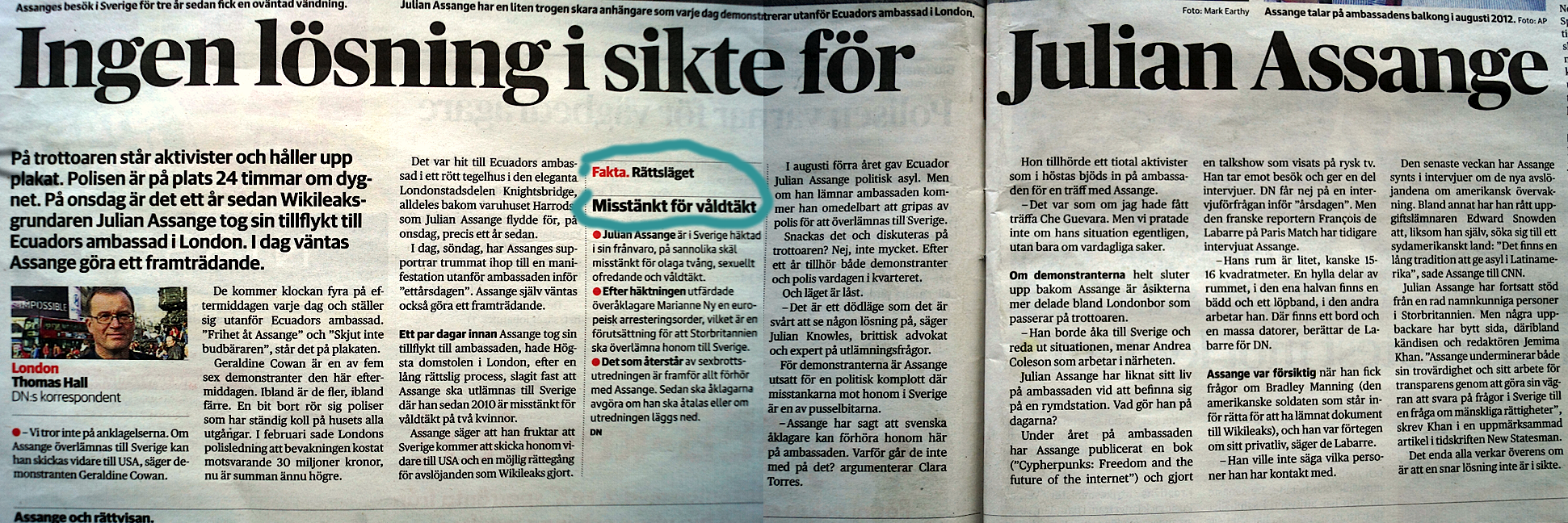
And regarding Assange, who DN reports is “legally suspected of rape”, “there is no solution at sight whatsoever” (Ingen lösning i sikte för Assange), says DN. These stabbings on the back of truth by Sweden establishment’s MSM  are done in the very moments that Ecuador’s Foreign Minister Patiño starting the talks with UK authorities in London for just that purpose - to find a solution to the deadlock produced BY SWEDEN with its prestige-bound negative of interrogating Assange in London. Further, the UK autorities as reported by BBC quoting a Foreign Office spokesman, "remain committed to seeking a diplomatic solution to this situation". The Swedish media campaign appears as double fold unethical, for neither DN dare to publish the complete reportage on-line for the general public, avoiding confronting international rebuttal to the inaccuracies of Hall, Christiansen and Leigh. Professors blogg reveals however the MSM plot here.
 Analysis by Prof. Marcello Ferrada de Noli

DNcover Assange16-2-13

DN First-page 16 June 2013: "Deadlock remains in the case Assange"

 Leading newspaper Dagens Nyheter (DN) surprises today the Swedish public with a first-page article on WikiLeaks, the whereabouts of contemporary whistleblowing which now “neglect WikiLeaks” to opting for classical newspapers which can now offer services and security level to the whistle-blowers that a "crippled" WikiLeaks is not any longer in position to offer. The reportage, composed by various articles in the main by foreign correspondent Thomas Hall (previously criticized in Professors blogg for his ostensible pro US-Army bias in the Swedish reporting on the NATO civil-killings in Afghanistan), and with corresponding political reflexions around the first year of Julian Assange at the Embassy of Ecuador in London.

''Leaks choses other than WL''

DN article: "Whitleblowers select other ways than WikiLeaks"

Journalist David Leight:
"We have not been in contact with WikiLeaks since three years. WikiLeaks has been since then practically out of the game"

Christian Christensen, media professor at Stockholm University, and which according to the DN reportage is "given by the WikiLeaks (official) site as contact-person in Sweden" [http://wikileaks.org/Press.html#wsf]:

"WikiLeaks was before the only organization that could guarantee anonymity and at the same time offer large spreading through cooperation with various newspapers. Today there are several alternatives for leaks (whistleblowers) in order to reach (the public) with their material"

Professors blogg comment: The authors above are not considering the true difference between the materials released by WikiLeaks and those published, for instance currently, by the MSM. These differences are mainly in terms of:

a) Quality of the material (in the sense of originality of the materials - nearly unfiltered for reasons of protecting identities, etc., instead of  being redaction "reportages" based in information from those materials)
b) Extension of the materials. The production available to the public at the WL sites equates – to the best of my knowledge – the material at disposition of WikiLeaks.
c) Free availability (public access) of the material beyond the readers or subscribers of the corporative MSM
d) Most important ethical issue of all: WikiLeaks is NOT an instrument of the power they exercise control upon. WikiLeaks exposes a system of  power-abuses in which many MSM have been a part of it.

mistänktfv
Article "There is no solution at sight whatsoever”
Encircled text in green-blue:

"The facts, juridically: Suspected of Rape"

My comment about the "deadlock" at the Embassy ("There is no solution at sight whatsoever”)
Nominally, the deadlock at the Embassy of Ecuador in London has been attributed to the negative of the Swedish authorities to conduct an interrogation with Julian Assange in London, directly in situ or by video-link - both procedures contemplated as standard in the Swedish legal praxis. However, the explicit political thesis presented in Professors blogg has been another. We have called the "Stalling hypothesis" and refers to:


As far the “accusations-item” is concerned, Sweden has at-large demonstrated it is NOT interested in ending the legal case. The only interest Sweden has demonstrated is in trying to obtain the extradition  – by any means possible – of Assange to Sweden, where Assange would be kept incommunicado-status behind bars as per standard legal procedure in Sweden.  The extradited-prisoner status of Assange (the status he would have if taken prisoner to Sweden) enables other “juridical” possibilities for Sweden, respective to USA, that were not accessible at the time he would have been interrogated by the Swedish prosecutor when he was free in Sweden. This situation may be one explanation why Assange was led to understand he was “free to travel”.
The Swedish legal extradition process against Assange, and the Swedish legal process regarding the accusation “by the two women” against Assange, are in the main two different things – and only euphemistically connected. Those two different things have wrongly been mixed up in the discussions around the “juridical case”. The synthesis of this dialectics confirms conclusively that the Swedish “legal” case against Assange is solely the political case of USA against WikiLeaks.
The known homogeneity or “consensus” between the Swedish political parties appears most visible in a) matters of foreign policy, b) issues of  “National security”, or c) any topic that might compromise the prestige or trademarks of Sweden abroad. And we find the Assange case implicated by the Swedish authorities in those three items altogether.

From Professors blogg article Timing the processes

-- Delaying Assange extradition-process for timing with process in the U.S.  On the possible reasons for the neglected interrogation of Julian Assange and the verdict delays. On WikiLeaks  and Democracy. Excerpts of the RT Interview in Stockholm and excerpts regarding the "protracting theses"
"In the U.S., the preparations for these trials are seeking a connection between WikiLeaks and Bradley Manning in terms of making Julian Assange accountable; is that what they are apparently looking after. And for that they need time. They need to prepare these materials. And for that, of course, it is highly convenient to keep Assange under arrest – and under the threat of the prospective of bring him here to Sweden, where he later he might be subject to an extradition petition."
In the RT interview 'MSM blacks Assange as US seeks Manning link', gives a further rationale for the "protracted" legal process is discussed. The thesis on the protracted Swedish process aimed to benefit a timing with the U.S. processes against WikiLeaks and its founder Julian Assange, finds support in some items at the time line "United States v. Manning, Assange, WikiLeaks, and the Press" authored by Alexa D. O'Brien. Some issues in this inteview are referred in the RT article US needs Assange under arrest ‘while seeking Manning link’
Excerpt:

RT -Julian Assange, hailed as a hero for leaking information through his site WikiLeaks, is facing an uncertain future. Swedish authorities want to question him in relation to sexual assault allegations; and some politicians in the U.S. want to extradite him there to stand trial for leaking tens of thousands of secret US government documents. Here discussing the on-going discussion surrounding Julian Assange is Professor Marcello Vittorio Ferrada de Noli. Professor, thank you for joining me. Moving straight on to Julian Assange, how do you put the balance: Julian Assange is facing justice? Or this is a political motivated assault on Julian Assange

Answer
Well, I have my doubts about that (facing justice). Because even considering the particularities of the Swedish legal system, Sweden would have also the possibilities of for instance questioning Assange by other means; by the phone, or by means of the Swedish Embassy in London, and so one and so forth. I would be more inclined to think that here is a political reason why this process has been put forward in he fashion it has been. I would believe that the reason for the arrest order issued by Sweden is to get WikiLeaks founder Julian Assange here into Swedish territory. By being here in Swedish territory he would be then subject to further extradition process in this case from Sweden to the U.S. I would believe that the reason of this (mimicking quotation marks) “legal” situation is more political. There is another strategy, in my opinion, behind the all thing.

“Operation stalling” 
The external-caused, protracted asphyxiation process of WikiLeaks (economically, politically, and in the organization structure) apparently corresponds to a psychological-warfare design. I called it “Operation stalling" [See "Swedish psychological warfare against Wikileaks and Assange"], as it aims appears to be the procrastination of the "legal" process and corresponding verdicts of extradition and the like.
While the Swedish part had ample possibilities of arrange the interrogation of Julian Assange already in Sweden, or even later while Assange was under police custody or arrest in London, what we could witnessed is instead an unnecessary or "constructed" delay. This procrastination seemingly was a sine-qua-non element in the strategy of asphyxiate Wikileaks economically; for the longer the process went on, the more aggravating turned the funding situation cause by the Visa/Mastercard transaction stop.

The strategically political damage to WikiLeaks was in this design a) partly to immobilize, delay or obstruct the analyses of materials and editing, of for instance the so called cables-production, b) partly to discourage the collaborative material would to be sent from the part of the public to Wikileaks, based in the notion that these individuals would wait until Wikileaks founder would be  “clear” of any wrongdoing.
The economic blockade aimed concomitantly to asphyxiate Wikileaks also politically, as its political base and collaborative cadres, all of them engaged only altruistically and ad-honorem, neither could endure such long period, almost a year now. This situation also affects WikiLeaks organizational functioning, as the longer the time the undefined process persists, the more expensive the costs, and ultimately the totally draining of such funds. Actually, this was pointed out by Julian Assange long time ago, when in one of his appearance’s outside the court in the previous hearings compared the enormous resources put up in this legal process by Sweden, Britain or elsewhere, in contrast with the hyper limited resources at his disposal.


Wednesday, 12 June 2013

No server is secure. The list of digital whistle-blowers is getting longer – By Rodrigo Ferrada Stoehrel

"Hammond and Anonymous have shown, albeit in his own way, that to produce change we must fight for ourselves. No one else will do it for us."
"It is said that knowledge is power, but it is power that decides what is knowledge. That is what the fight is about." Rodrigo Ferrada Stoehrel

The Swedish newspaper Aftonbladet published today (11 June 2013) "No server is secure. The list of digital whistle-blowers is getting longer" [Ingen server är säker. Listan av digitala whistleblowers blir allt längre], an article authored by Rodrigo Ferrada Stoehrel, PhD student in Media and Communication Sciences, Umeå University. Here below an (unofficial) translation by Professors blogg of the article based on the Aftonbladet published version.

Rodrigo article 

No server is secure

By Rodrigo Ferrada Stoehrel

The trial against Bradley Manning continues unabated; and Edward Snowden (the NSA-leak) revealed yesterday, worldwide, details on his whereabouts. The list of digital whistle-blowers is getting longer. Two weeks ago, the man who hacked the security firm Stratfor, and sent the information to Wikileaks, was brought to trial in a lawsuit that raised questions about who really monitors whom in the modern information war -- and in which the balance of power is far from obvious.

Criminal or political prisoner? terrorist or freedom fighter?

In a legal sense, Jeremy Hammond’s hacking is held a criminal activity regardless of the intentions he had. In political meaning, Hammonds and other activists like him are hacking in a world of economic and state secrets - and revealed them to the public.

On May 28, the trial in New York against cyber activist Jeremy Hammonds was one of the main discussions on Twitter. It was discussed whether the potential penalty of ten years was fair or disproportionate, and on the possible causes of the long sentence. It was discussed whether the American judicial system is trying to set an example against hacking, or it just an expression of fear. Suddenly disclosures of confidential political-economic information challenges the democracy’s image, which has been painted for long, and relatively, unhindered.

The 28-year-old Hammond was arrested in 2012 along with four other activist accused to hacking into the private U.S. security and intelligence firm Stratfor (Strategic Forecasting Inc.). In December 2011, they had leaked five million emails to Wikileaks, which in turn spread the information to the media worldwide. Hammond was nicknamed "Robin Hood" because he also must have stolen credit card information (not encrypted, according to himself) from Stratfor and donated nearly 700,000 dollars to various aid organizations. A sum that is now completely returned to the company.

After seizing part of the documents via Wikileaks, both the UK's The Guardian and U.S. Rolling Stone Magazine reported (27 and 28 February, 2012) about how Stratfor secretly collaborated with the U.S. Department of Homeland Security (Department of Homeland Security). The goal was to develop strategies for civilian domestic surveillance.

The (WikiLeaks’) Stratfor-leak, and Edward Snowden's revelations about the U.S. government-led mass surveillance, allows us to peer into an ever darker shadow-world of both government and private companies spying on their own people. A process which is incompatible with democratic values, according to Abi Hassen, a lawyer and coordinator of the U.S. National Lawyers Guild. As Hassen declared to the site Sparrow Media: "Today's trial should be instead the springboard for an investigation of Stratfor, and not an occasion used to sentence a young man to ten years in prison for political activism."

It is in many ways ironic that Hammond can get ten years for hacking, while the young- rapists from Steubenville High School in the USA got one, respectively two, years in juvenile detention-institutions. The youngsters were arrested after Anonymous - the political movement that has been associated to Hammond and the hacker collective LulzSec - leaked video evidence.

On Twitter, the debate has also centred on the New York judge Loretta Preska could be accused of bias. This is because the revelations indicating that her husband's law-firm Cahill - one of Stratfor’s customers – was found in the material that was hacked. Yet others maintain that Hammond’s hacking should be regarded as idealistic political activity -- civil disobedience.
The debate in Twitter has also to do about enabling an alternative knowledge form, about an attempt to approach the truth by circumvolving the democratic facade  - and to publish it. We have never been in greater need of information and corporation-transparency.
From this perspective, the activities by Hammond and Anonymous are something more than a classical computer hacking.
No server can hide information in an absolutely safe way. And this has a symbolic value. No civilian group can ever match the institutional power-infrastructure in what war technology is concerned. However, in a cyber or information-war those terms change, at least theoretically. It is here where the hacker-culture as a political movement comes into play.
As globalization expands, also increases the risk of concentration of the political and economic power. Ensuing this logic, the neo-liberal version of democracy will not change.
Nor shall economic and political inequalities be balanced. None of the beneficiaries of the current power structure will take up the fight for the oppressed, which comprise the global population majority.
Hammond and Anonymous have shown, albeit in his own way, that to produce change we must fight for ourselves. No one else will do it for us. It is said that knowledge is power, but it is power that decides what is knowledge.
That is what the fight is about.

Rodrigo Ferrada Stoehrel
PhD student in Media and Communication Sciences, Umeå University, Sweden